

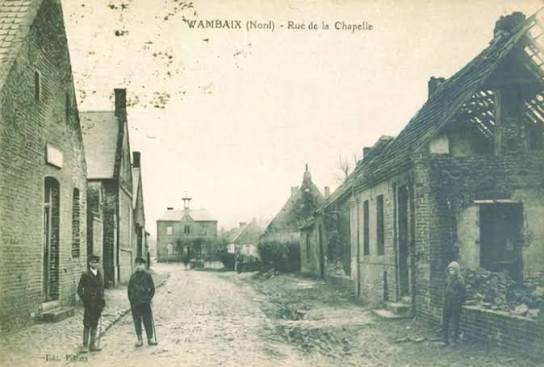
The most striking thing about my French ancestors is how ordinary they probably were. They were not nobles, soldiers or famous figures. Yet families like the Lemaires and Cuisettes formed the backbone of rural France. They witnessed the transformation of Cambrésis from a contested frontier to part of the Kingdom of France, survived poor harvests and wars, and passed on their lives through the parish registers. The fact that you can still identify them by name after more than 320 years is, in itself, rather remarkable.
We know very little about my fourth-great grandparents, Antoinette Cuisette and Joseph Lemaire, other than where they lived – Wambaix in northern France – and when – the late 17th and early 18th centuries. But we know what life was like for people living in that area at that time in rural France, so we asked AI to imagine what life would have been like for them, using known historical records about the area.
And this is what it came up with, which may be imaginary, but probably quite close to the truth. And it’s rather charming.
A Summer’s Day in Wambaix, Around 1700
The first light appears long before the sun rises above the fields east of Cambrai.

There are no clocks in the Lemaire or Cuisette homes. Time is measured by habit, by the crowing of cockerels, and by the gradual lightening of the sky. Somewhere in the village, the church bell rings for the Angelus, its sound carrying across the fields of wheat and rye that surround Wambaix.
Fifteen-year-old Joseph Lemaire is already awake.
He shares a bed with one of his brothers in the loft above the family’s main room. The straw mattress rustles as he pulls on a coarse linen shirt and woollen breeches. Downstairs, the single room is still smoky from last night’s fire, which has smouldered through the night beneath the great chimney.
His mother has already baked dark rye bread in the communal oven the previous day. Breakfast is simple: bread, perhaps rubbed with garlic, and a bowl of warm pottage left over from supper. If the family owns a cow, there may be a little milk. Meat is rare except on feast days or after a pig has been slaughtered.
Across the village, seventeen-year-old Antoinette Cuisette begins her day in much the same way.
She helps her mother rekindle the fire, fetches water from the village well, and feeds the chickens scratching around the yard. A few geese complain loudly as she scatters grain. The family’s pig, perhaps their most valuable possession after the horse, roots impatiently in its pen.
By sunrise the whole village is stirring.
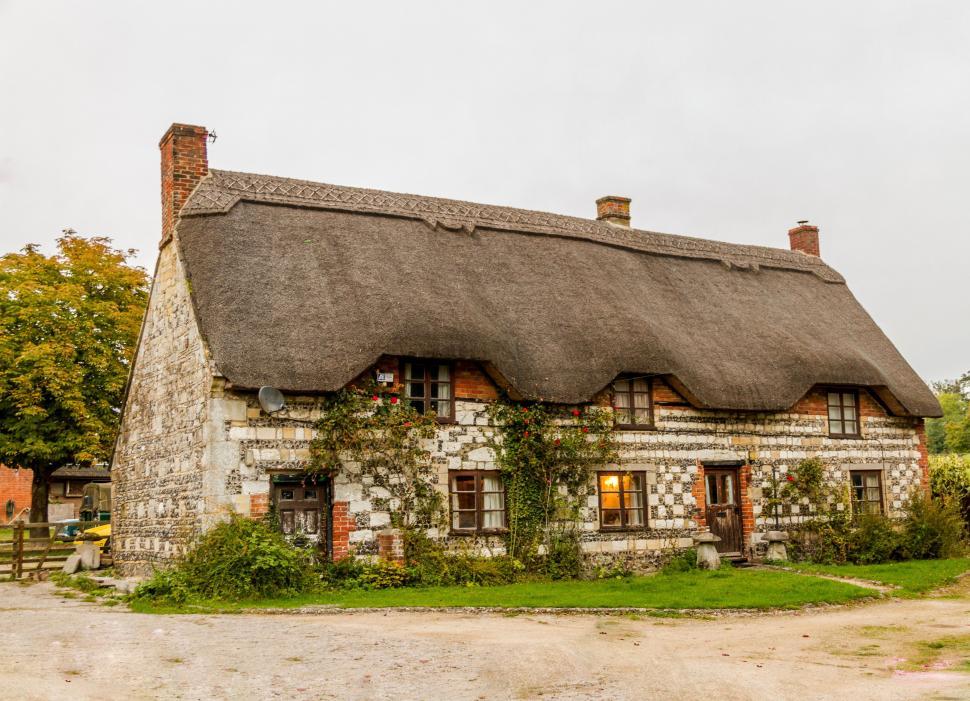
Only a few dozen houses stand along the lanes of Wambaix. Most are timber-framed with walls of wattle and daub or local brick, their roofs thatched or tiled. Behind each lie vegetable gardens, orchards and barns.
Everyone knows everyone else.
The Lemaires and the Cuisettes have probably known one another for generations.
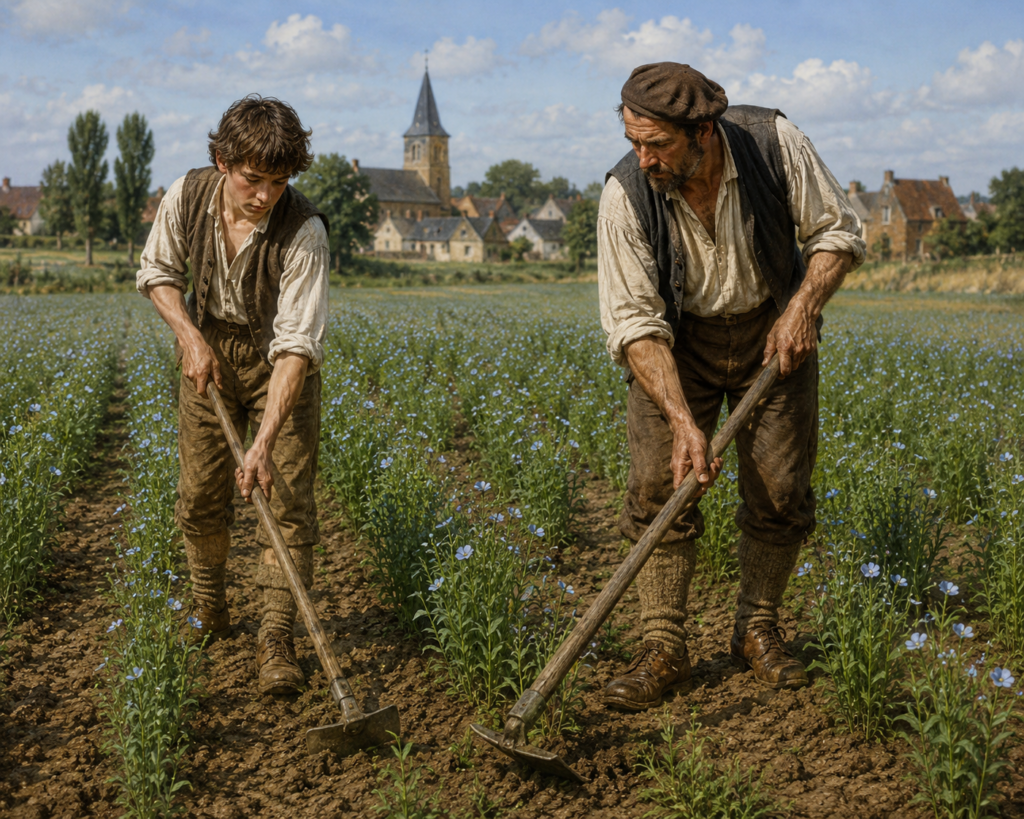
Joseph spends the morning in the fields with his father.
It is July, and the wheat is nearly ready for harvest. They inspect hedges, mend a broken fence and hoe weeds between rows of flax that will later become linen. Heavy horses pull wooden ploughs where fields are being prepared for autumn sowing.
The work is relentless.
By fifteen, Joseph is no longer considered a child. He can handle horses, swing a scythe, repair tools and bargain at market. His father is quietly judging whether he is becoming the sort of man who can eventually support a family of his own.
Antoinette’s work is no less demanding.
She spins flax into thread while watching younger siblings. Later she joins other village girls washing linen in a nearby stream. The work is hard on the hands, but it is also one of the few opportunities for conversation.
News spreads this way.
A cousin in Cambrai has married.
Someone’s cow has died.
Taxes may be increasing again.
There is talk of another war somewhere beyond the horizon, though wars have become almost ordinary in this border country.
Occasionally soldiers pass through on the roads toward Cambrai, reminders that only a generation earlier this district changed from Spanish to French rule.
At midday the families pause briefly.
Dinner is little different from breakfast: vegetable soup thickened with barley, onions and cabbage, perhaps flavoured with bacon if any remains. Ale or weak beer is safer to drink than untreated water.
Then everyone returns to work.
Summer daylight is too precious to waste.
On Sundays life changes completely.
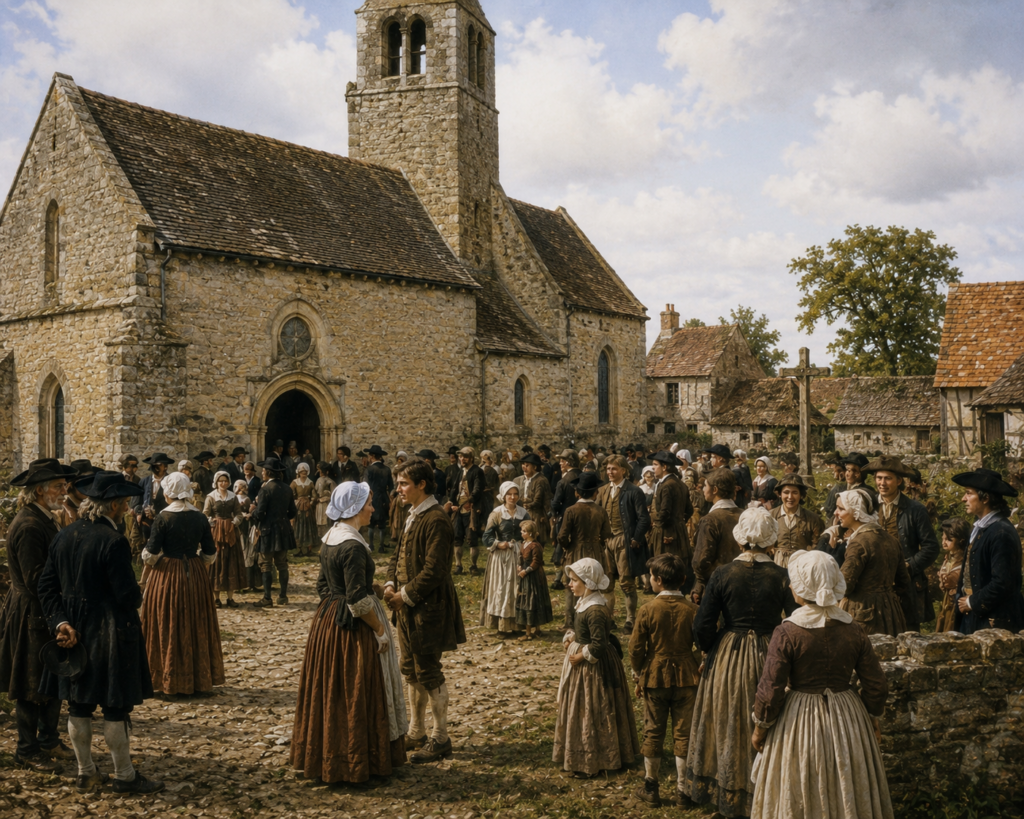
The entire village gathers in the old parish church that stood where Saint-Amand Church stands today.
Joseph and Antoinette sit with their respective families while the priest celebrates Mass in Latin.
Neither understands every word.
The language of daily life is not the elegant French of Versailles but the local Picard dialect, mixed with expressions inherited from Flemish neighbours. The King’s officials speak one language; the villagers another.
After Mass, however, the churchyard becomes the centre of village life.
Children play.
Neighbours exchange news.
Young men and women steal glances at one another while pretending not to.
If Joseph has begun to notice Antoinette, it happens here.
Not with romance as we imagine it today, but through familiarity. In villages as small as Wambaix, marriages usually grew from years of shared work, shared worship and the quiet approval of both families.
As evening falls, the fields glow golden in the last sunlight.
The day’s work finally ends.
The family gathers around the hearth. Someone repairs harness leather. Someone spins wool. An older relative tells stories of the terrible wars that ravaged the countryside before the Peace of Nijmegen, when armies marched back and forth across Cambrésis and villages feared every distant column of smoke.
Outside, the night is almost completely dark.
There are no street lamps.
Only the stars, the moon and the occasional lantern guide anyone foolish enough to venture beyond the village after sunset.
Joseph climbs once more into the loft.
Antoinette says her prayers beside her bed.
Neither can know that within a few years they will marry, raise children in this same little village, and begin a line of descendants that, more than three centuries later, will lead one of their descendants in Australia to wonder what life was like for two ordinary young people in Wambaix around the year 1700.