

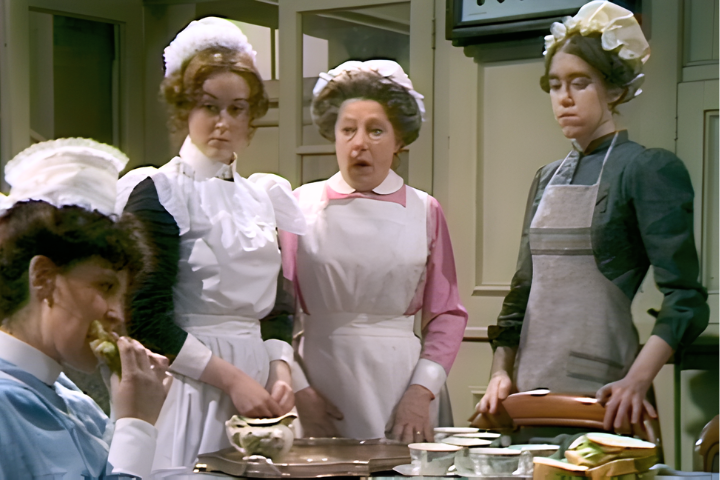
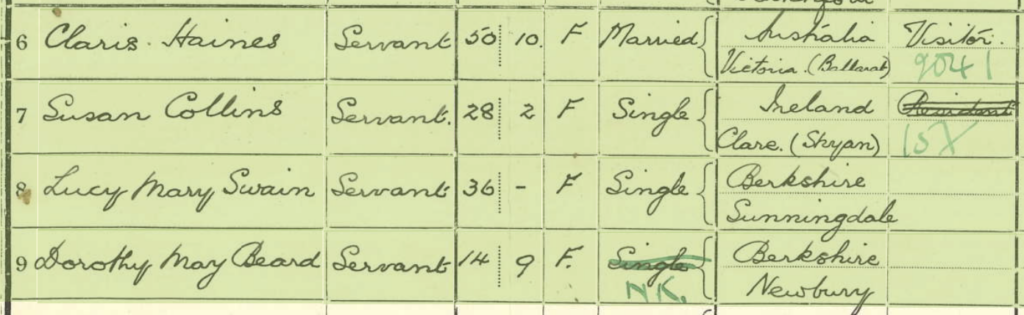
TV series like Upstairs Downstairs and Downton Abbey captured the imagination of the world. But for one of our relatives, that was her world. Dorothy Tolton – known to everyone as Doll – was our Aunt. As a 14 year old she had her first job as a ‘tweeny’ – properly known as a between maid, working in the household of a wealthy member of Lloyds of London, where the world’s insurance was bought and sold. The name ‘tweeny’ comes from her position between two departments — she worked under both the cook/kitchen maid and the housemaids, filling gaps wherever needed. She was usually a young girl, often 13–16 years old, frequently her first job in service. As a 14-year-old, Doll was a very typical tweeny.
Her work was relentless and unglamorous — essentially the drudgery that other servants didn’t want to do:
Kitchen duties: Lighting the kitchen range early in the morning (often 5–6am), cleaning it, and keeping it fuelled. Scrubbing pots, pans, and the kitchen floor. Preparing vegetables and running errands for the cook.
House duties: Carrying coal scuttles to fireplaces throughout the house, emptying and cleaning chamber pots, scrubbing back stairs, polishing boots, and carrying hot water for baths.
Errands: Fetching supplies, answering the back door, and any odd job required by the upper servants.
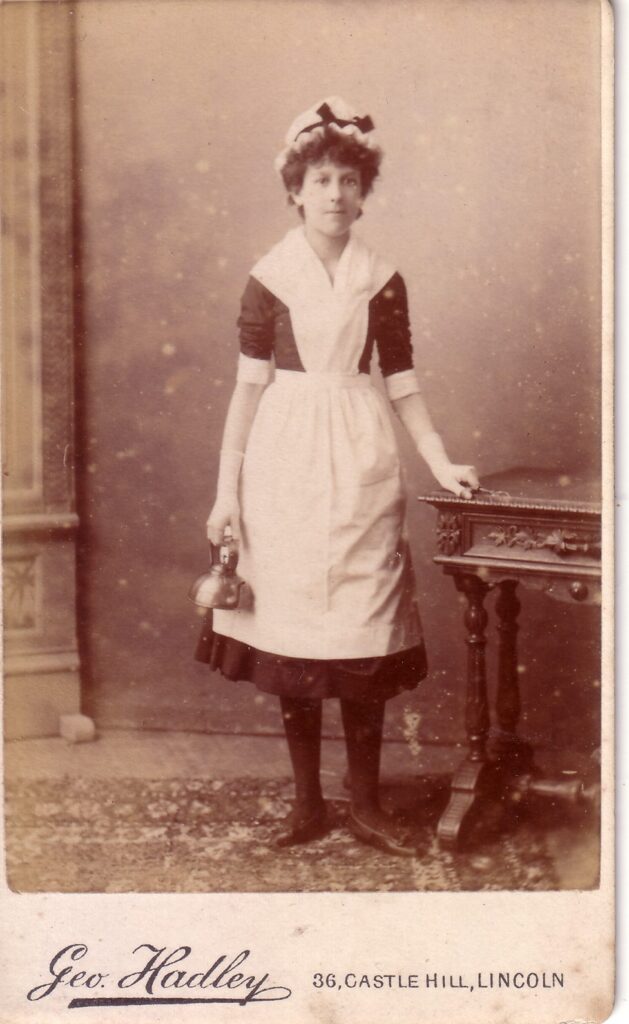
She occupied the very bottom rung of the servant hierarchy — below the housemaids, kitchen maid, and certainly far beneath the housekeeper or lady’s maid. She ate separately or last, had the smallest and coldest room (often in the attic or basement), and was expected to be invisible to the family. She addressed upper servants as “Miss” but was herself addressed by her first name or even a generic name the household preferred.
A between maid’s day could run from before 6am until 9 or 10pm, with very little time off — perhaps a half-day on Sunday and one afternoon a week. Pay was extremely low, often just a few pounds per year, though room and board were included. For many girls from poor rural families, even this was better than the alternative. Despite the hardship, the role was seen as a starting point. A capable tweeny might work her way up to housemaid, then parlour maid, and eventually — with years of experience — perhaps housekeeper. It was one of the few structured career ladders available to working-class women at the time.
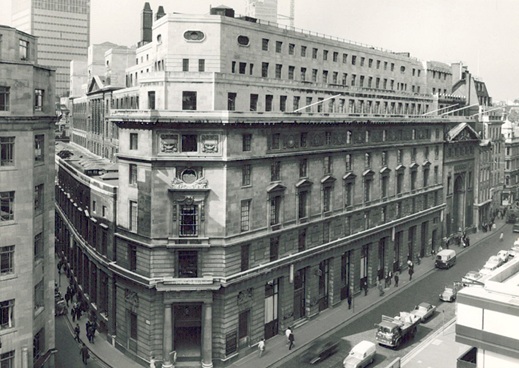
Doll was working in the home of John Armour MacMillan, a member of Lloyds of London. Lloyd’s was not an insurance company in the conventional sense — it was a marketplace where insurance was bought and sold. It traces its origins to Edward Lloyd’s coffee house in the 17th century, where merchants and ship owners gathered to arrange marine insurance. By the early 20th century it had evolved into a highly organised but still distinctly personal market. Individual members of Lloyd’s, like MacMillan, were known as “Names“ — private individuals who provided the financial backing for insurance policies. To become a Name you had to demonstrate substantial personal wealth, as membership required depositing funds as security. It was largely a club of the wealthy upper and upper-middle classes — landowners, gentlemen of independent means, retired military officers, and businessmen. The crucial and defining feature of being a Name was unlimited personal liability. You underwrote policies with everything you owned — your house, investments, and personal assets were all on the line. The famous phrase associated with Lloyd’s was that members were liable “down to their last cufflink.”
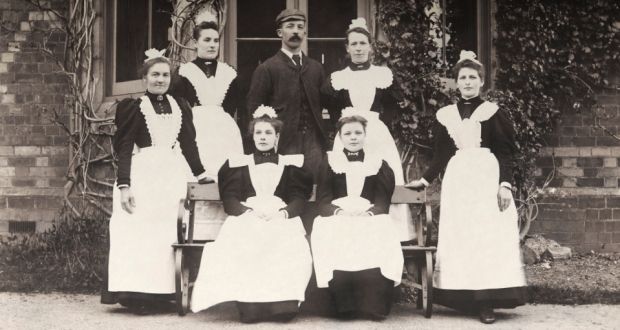
Macmillan lived with this wife, Clara, his son Alastair and daughter Margaret. The household was run by four staff – a nurse, a parlour maid, a cook, and a tweeny.
Membership carried considerable social prestige. Being a Name at Lloyd’s signalled wealth, respectability, and connection to the commercial heart of the Empire. For many Names, the actual business was handled almost entirely by the underwriting agents on their behalf — they collected premiums as passive income and rarely set foot in Lloyd’s Room themselves. It was, for the comfortable classes, a gentlemanly way to put idle capital to work.
The between maid largely disappeared after World War I, when young women found better-paid work in factories and shops, and the rigid hierarchy of large domestic households began to collapse. By the 1930s, the role was already rare. For Doll, by 1931 she had married Percy Tolton,
By the time of the next census in 1939, Doll and Percy had moved into the upstairs flat next door to Doll’s father in Fulham and had two young daughters.
But her time as a tweeny represents one of the most overlooked figures in social history — young, overworked, and almost entirely absent from the historical record, yet essential to the smooth running of the Edwardian and Victorian home.