
After AI was able to use historical references to imagine what life would have been like for my French ancestors in the tiny town of Wambaix in northern France, I wondered what would happen if we challenged AI to do the same process with my wife’s ancestors – so I picked Margareta Larsdotter, born in 1510 in Skaraborgs Lan, Sweden – Annette’s 14th-great-grandmother.
Ai pointed out an interesting link between the two families – By the mid-1500s, both families were living in parts of Europe undergoing profound religious change—but in very different ways. My French ancestors in Cambrai remained under strong Catholic influence and would later experience the turmoil of the Wars of Religion. Annette’s Swedish ancestors lived through Sweden’s official adoption of Lutheranism under Gustav Vasa. It’s a striking contrast: two branches of our extended family history experiencing the Reformation from opposite sides of Europe.
So what was life like for Margareta and her husband Raguald, living in Strängnäs, Södermanland. This is AI-inspired imagination but based on known historical facts about life at the time.
A Day in the Life of Margareta Larsdotter and Raguald Petersson
Near Strängnäs, Sweden, about 1555
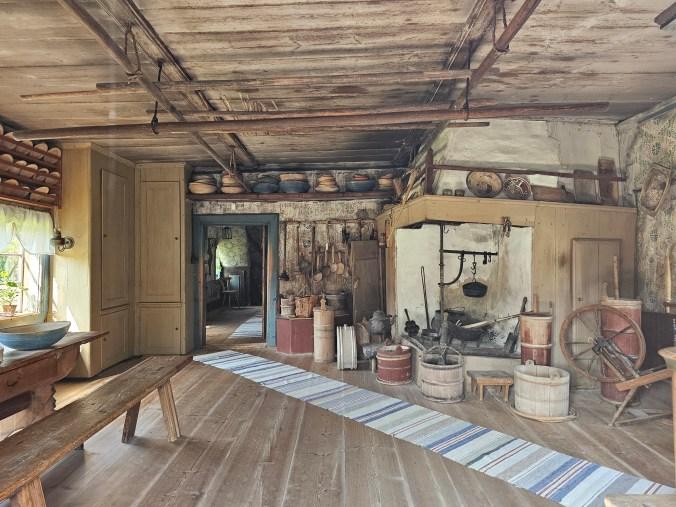
The first sound is not the rooster but the cattle. Before dawn, the cows shuffle in their stalls beneath the same roof that shelters the family. Their warmth helps keep the timber house from freezing during the long Scandinavian nights.
Margareta is awake before anyone else.
At forty-five years old she has been mistress of this household for more than twenty-five years. Her hands move automatically in the darkness, pulling on a linen shift and heavy woollen dress before covering her hair with a white linen kerchief. Beside her, Raguald is already stirring. Years of farming have stiffened his back, and he pauses for a moment before standing.
A woman was expected to manage much of the household economy. Butter, cheese, linen, clothing and preserved foods were often entirely her responsibility.
Outside, a pale mist hangs over the meadows beside Lake Mälaren.
The air smells of damp earth, pine forest and wood smoke.
Morning
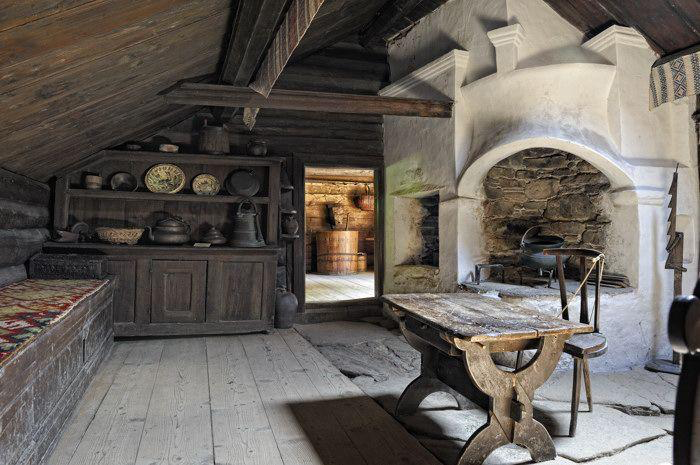
The hearth never truly goes out. Hidden beneath yesterday’s ashes are glowing embers, which Margareta coaxes back into flame with dried birch bark. Soon the room fills with the comforting smell of rye bread warming beside a pot of barley porridge.
The children and younger servants emerge from their sleeping benches.
Their son Reinhold, now a grown man with children of his own, has come from a neighbouring farm to help with the hay harvest. His eldest son—Margareta’s grandson—eagerly follows his grandfather outside carrying a wooden rake almost as tall as himself.
Breakfast is simple:
- coarse rye bread
- butter churned only days before
- salted herring
- porridge
- weak ale brewed during the spring.
Nobody lingers over the meal.
Summer is too precious.
In the Fields
Raguald swings his scythe in long, even strokes.
The meadow grass falls in neat rows before him.
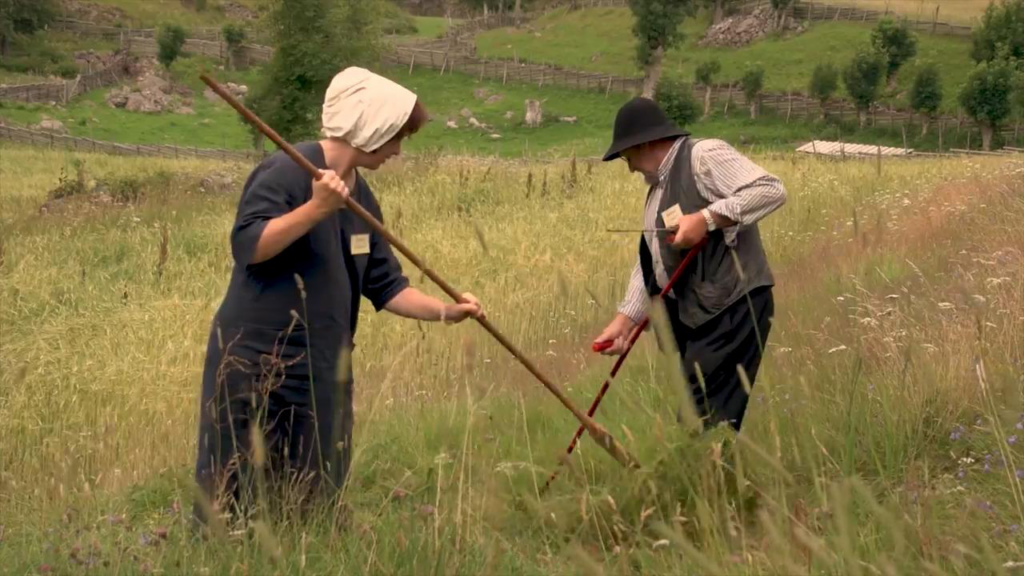
Behind him walk Margareta and the younger women, spreading the cut hay with broad wooden rakes so the July sun can dry it evenly. Every handful matters. This hay will keep the cattle alive through a winter that may last half the year.
Children gather fallen branches for firewood while keeping watch over grazing sheep.
Nobody is idle.
Margareta notices everything.
She reminds one granddaughter not to trample the flax, checks whether the cows have wandered too close to the oats, and quietly judges whether rain is building over the western forests.
Experience has taught her to read the sky better than any calendar.
Midday
The bells of Strängnäs Cathedral carry faintly across the countryside. Even miles away, their sound marks the passing hours.
The family rests briefly beneath an oak tree. Margareta unwraps cheese, onions and dark bread from a linen cloth while Raguald shares news heard at the last market.
The King has demanded more taxes. Another church has removed its old saints’ images. A neighbour’s son has gone east to serve in the army.
The world seems to be changing more quickly than either of them remembers.
Margareta still recalls, as a child, the Latin Mass of her youth. Now the village priest preaches in Swedish from the new Lutheran Bible. She misses some of the old feast days but says little. Like most country people, she has learned that kingdoms may change while crops still need harvesting.
At Home
By late afternoon the work shifts indoors. Milk is skimmed for cream. Butter is churned. Cheese is pressed beneath heavy stones Margareta spins flax into fine linen thread while keeping half an eye on a kettle suspended above the fire.
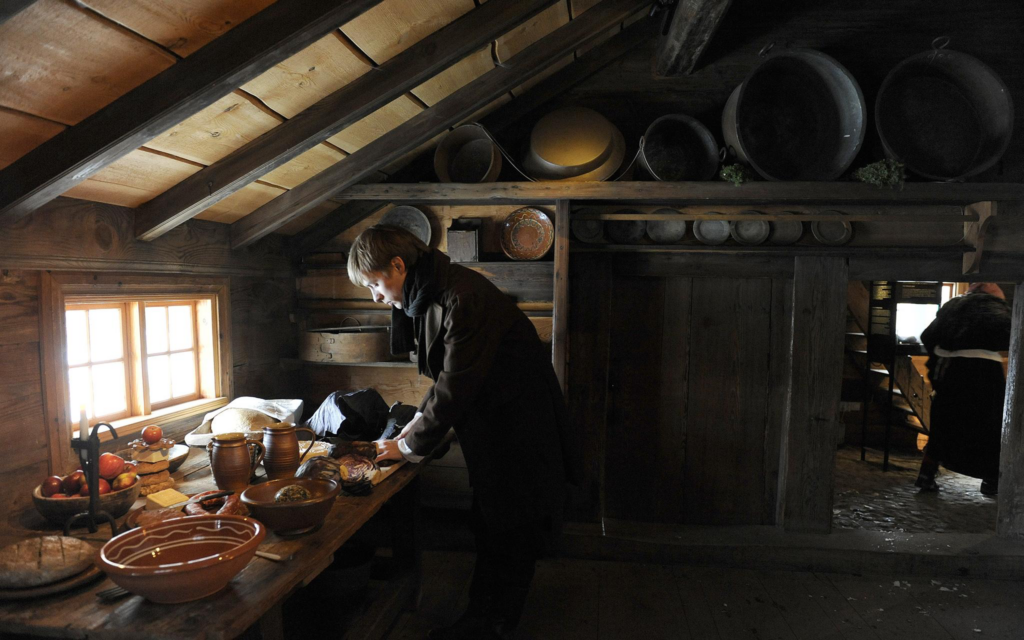
She has become the keeper of knowledge that no one writes down. Which herbs soothe a fever. How much salt preserves meat. Which cow gives the richest milk. When to sow rye after an early frost.
The younger women learn simply by watching her.
Evening
As dusk settles, the household gathers once more around the fire. The smoke curls slowly upward toward the roof vent. Raguald repairs the handle of a wooden shovel with his knife. One grandson practises carving a spoon. Another nods off against the family dog. Margareta mends a woollen stocking by the light of a tallow candle.
Conversation drifts from the day’s work to memories. She speaks of winters when wolves came close to the farm. Of the terrible rumours from Stockholm many years ago. Of seeing monks leave abandoned monasteries after the King’s reforms.
To the children these stories already sound like another age.
Night
Outside, darkness settles over Lake Mälaren. Somewhere across the water, candles flicker in the windows of Strängnäs, where bishops once ruled and now Lutheran pastors preach.
Inside the farmhouse the fire burns low.
Margareta quietly thanks God—not in the Latin prayers of her childhood, but in the Swedish words she has gradually learned over the past thirty years.
Tomorrow will be much the same.
The hay must still be gathered. The cows milked. The bread baked. The children taught.
The seasons have little interest in politics.
What strikes most about Margareta is that she lived through one of the greatest transformations in Swedish history while probably never travelling more than a few dozen kilometres from home.
She was born into a medieval Catholic kingdom. She watched Sweden become an independent nation She saw the monasteries disappear, the Church change its language, and the King extend his authority into every parish.
Yet the rhythm of her own life remained governed by older, more enduring forces: the weather, the harvest, family, and faith.
When she died around 1580, aged about seventy, she may well have been remembered not as someone who lived through extraordinary times, but simply as “old Margareta”—the woman who knew when to plant, how to heal, how to keep a household together through hard winters, and who could remember how things had been before the world changed.