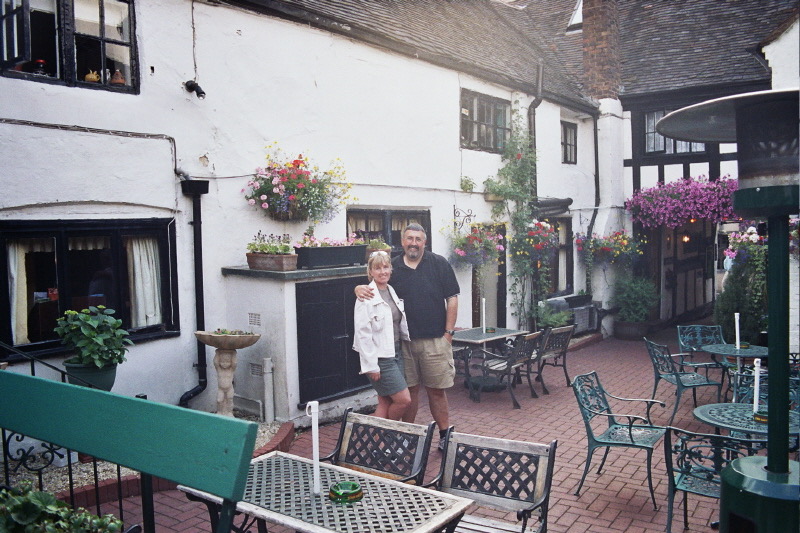

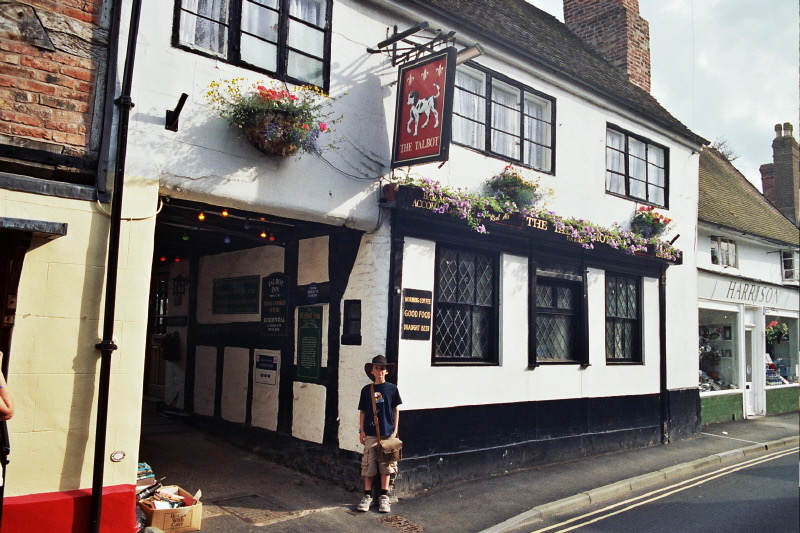
The Talbot Inn in Much Wenlock, Shropshire was my grandparents’ home for most of the 1940s and 50s. In fact, I spent a fair proportion of my first two years there. But the Inn’s history goes back much, much further. The picture at the top shows our son Nicholas outside the pub on a visit to the UK in 2004.
Allan and Beatty Lee moved there in the early 1940s. We don’t know an exact date – but we do know that it was here, in 1942, that they received the devastating news that their son, another Allan, had been killed in action after the raid on Dieppe during World War 2. It was here that my grandmother, Beatty, died from cancer in 1956. And my parents – particularly my mother – helped Grandad run the pub after Beatty died. And since my mother was there – so was I.
My memories are hazy – I think Grandad left the pub around 1959, so I was still only a toddler. But I remember a huge wooden staircase (apparently a Jacobean masterpiece) and the smells of beer and cigarette smoke from the bar and disinfectant from the yard. And chickens. I can remember my other grandmother walking out of the pub garden at the back (it had its own bowling green in those days) and down a lane to see the chickens.
But Grandad was just the latest landlord of an inn with a history going back to the 14th century.
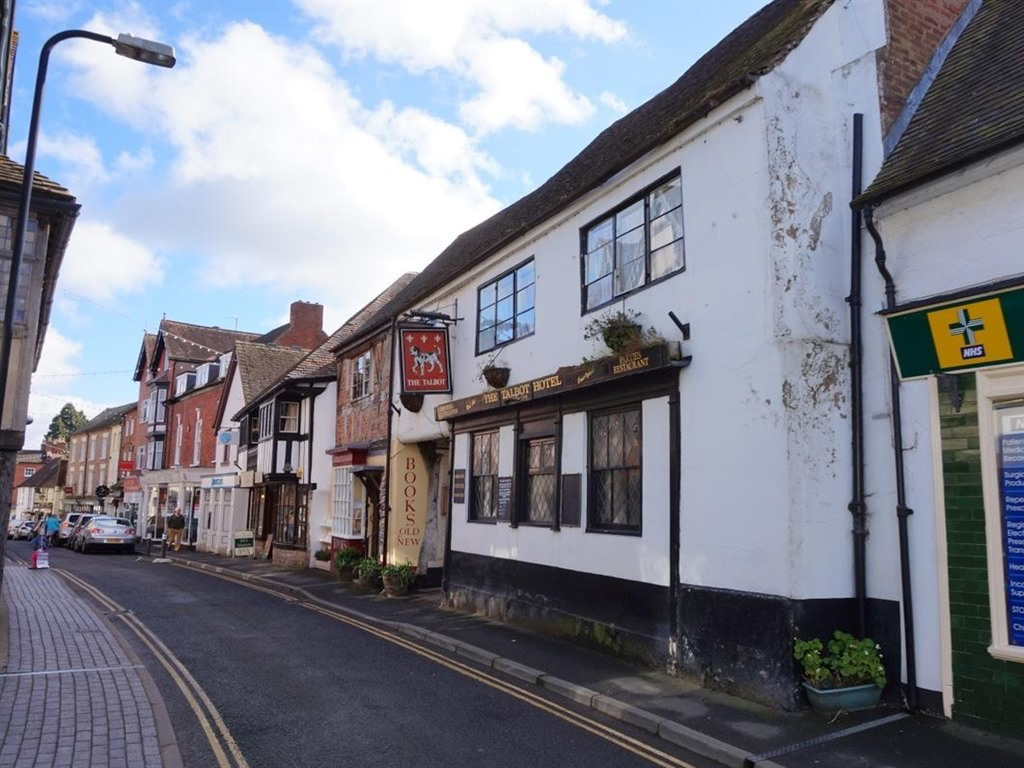
Originally known as the Abbott’s Hall, the Talbot dates back to 1360. It is thought to have been the Almoner’s House, a hostel for travellers and centre for almsgiving. It has been an Inn ever since. The Talbot is situated in the centre of the historic High Street, Much Wenlock originally known as Spittle Street. The current building is largely an early 17th century construction, covered with an early 19th century stucco.
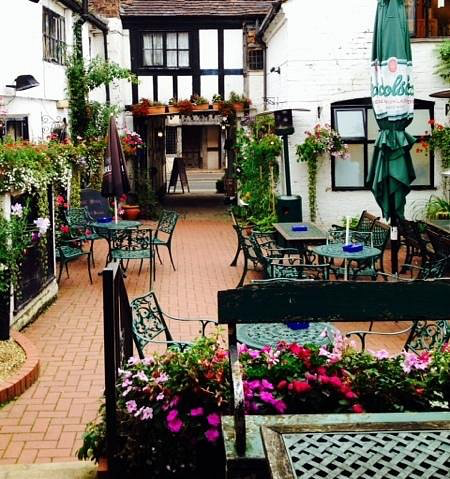
The carriageway on the left hand side of the building leads to a courtyard which is now used as an open air seating area but would originally have probably led to stables for the horses of weary travellers.
Almoners were church officials, in charge of giving alms, and distributing the money to the (deserving) poor. It’s where we get the world ‘almshouses’ from. It was the medieval equivalent of the welfare state.
Medieval inns were big business – historian John Hare from the University of Winchester writes “at a time of growing specialism, they were a crucial part of the economic infrastructure of the country”. Many inns offered only communal sleeping, but gradually private and locked rooms became more and more prevalent. Inns were often centres for local commerce.
John Hare says innkeepers were often at the centre of medieval urban life:
“The conclusion is that in later Medieval England there was a regular provision of inns in accordance with the size and importance of the towns. Inns generated substantial rent and were evidently felt to be worth considerable investment. Innkeepers were among the rich and influential members of the town. Inns played a vital role in evolving and prospering economic, social and political life of the nation in this period.”
Inns, Innkeepers and the Society of Later Medieval England, 1350 – 1600
By John Hare, University of Winchester
At the back of the pub, overlooking what was the the bowling green, was the Tablot Inn’s Malthouse which dates back to 1762. In those days, innkeepers malted Barley and brewed their own beer here until the middle of the 19th century. (Today the Malthouse has been converted into accommodation).
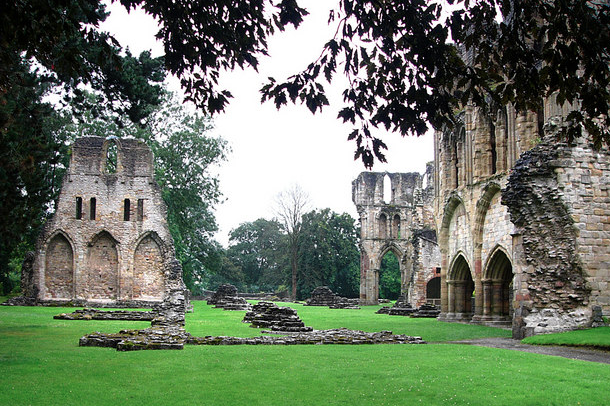
Wenlock itself has a fascinating history. It’s known to have grown up around an abbey or monastery founded around 680AD and some historians believe it could be one of the possible locations where a Sub-Roman British Christian community may have survived the Anglo-Saxon occupation. One of the most popular attractions in Wenlock today is Wenlock Priory, or St Milburga’s Priory, is a ruined 12th-century monastery, founded between 1079 and 1082, on the site of the earlier 7th-century monastery. In 1101 bones, believed to be those of Saint Milburga, were discovered beneath the floor of the old church. According to popular stories, was endowed with the gift of healing and restored sight to the blind.
Some gruesome history: 11-year-old Alice Glaston from Little Wenlock was hanged together with two men in Much Wenlock on 13 April 1546, for an unknown crime. She is the youngest known girl legally executed in Great Britain.
Much Wenlock has become known as the birthplace of Wenlock Olympian Games set up by William Penny Brookes and his Wenlock Olympian Society (WOS) in 1850. He is credited as a founding father of the modern Olympic movement.
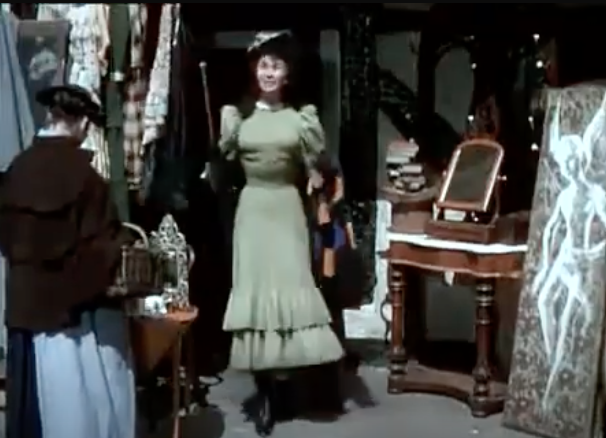
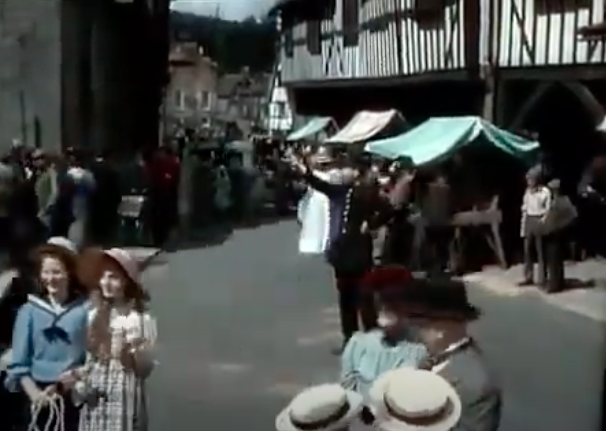
In 1949, the Talbot was used – along with the rest of Much Wenlock – as a setting for the Powell/Pressburger move ‘Gone to Earth’, starring Jennifer Jones. The film also featured Sybil Thorndike, George Cole (a long time before ‘Minder’) and Hugh Griffith, along with some distinctly dodgy ‘mummerset’ country accents. In the upper picture above, Jennifer Jones is standing in what I think may be the archway of the Talbot.
In 2019, Much Wenlock was featured by The Sunday Times as one of the best places to live in the UK.
The Talbot features large in our family history – a lot happened there, some sad, some happy. We continued to visit for years after Grandad left and my parents had many friends from their time helping in the pub.