

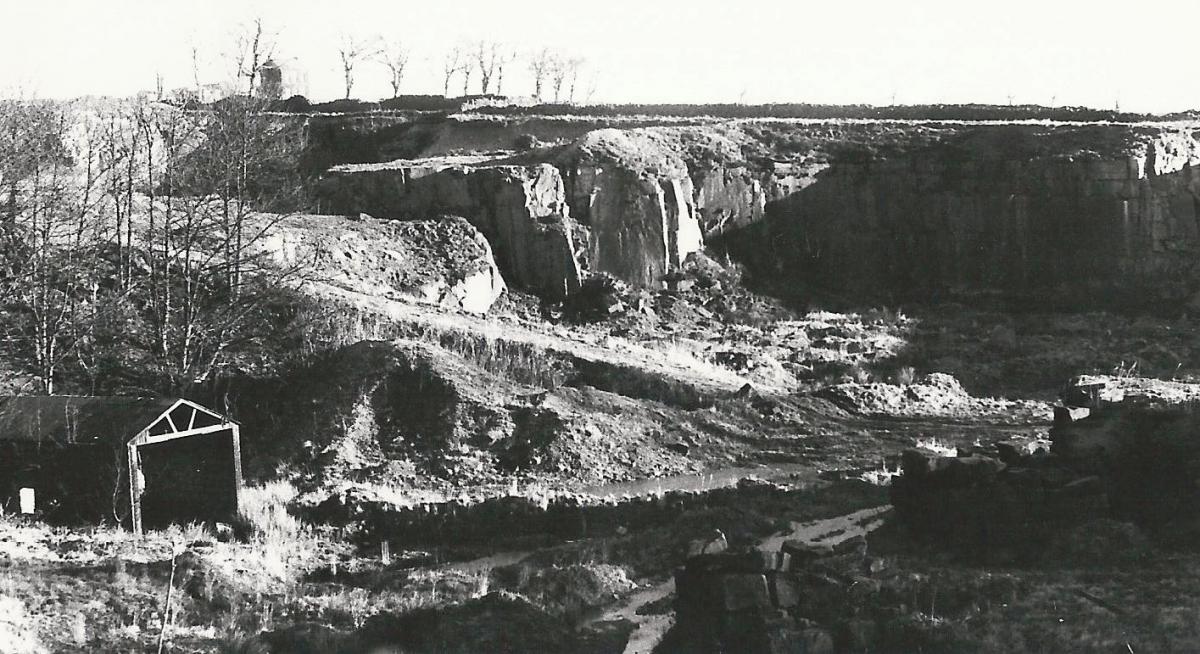
Looking at the census records of third-great grandfather George Fenton Pearson revealed that he was a ‘Stone Delver’ – not an occupation I’d ever come across. But it turns out a stone delver is a quarryman – the term ‘stone delver’ gradually fading from use during the 19th century.
George was living in Bramley, near Leeds. Bramley is famous for Bramley Fall Stone, stone which belongs to the Millstone Grit series. According to Wikipedia, It is one of the cheapest and best-adapted English stones for extensive engineering works, docks, locks and railways, and for large millstones, grindstones, engine-beds and foundations. During the 19th century, it was in great demand as great engineering works were undertaken.
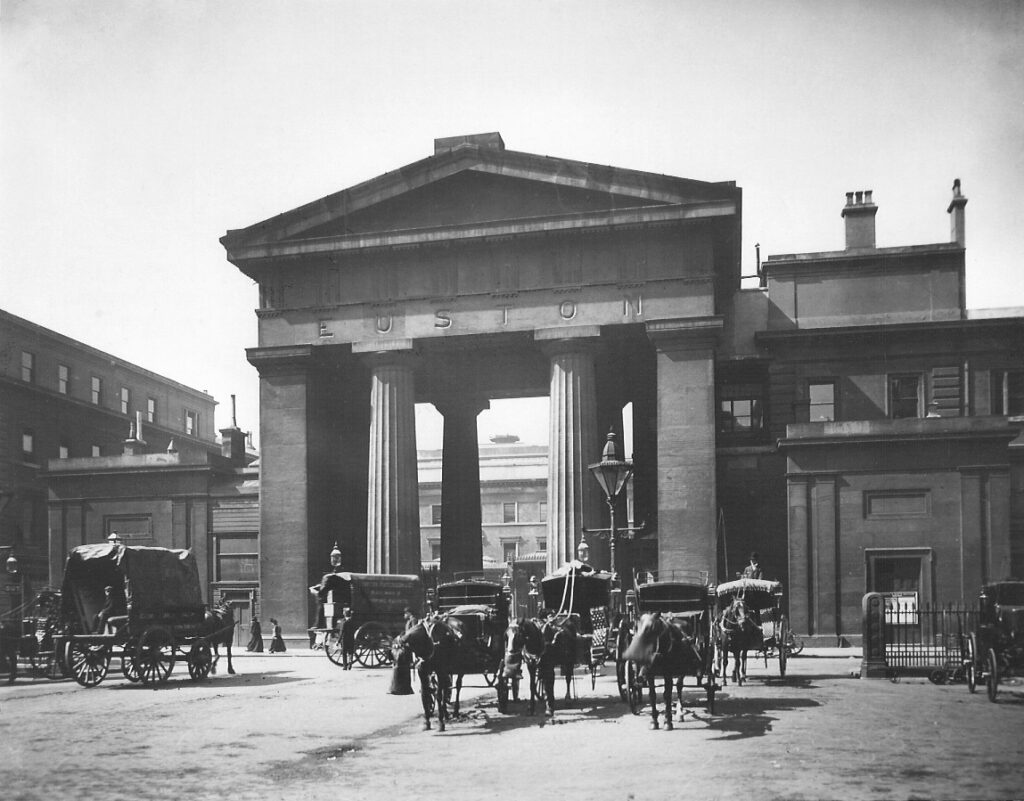
A typical example of the use of Bramley Fall stone was the Euston Arch (above), built in 1837 (and demolished in 1962), which was the original entrance to Euston station. (Sadly when it was demolished, the stone was taken away and used as fill for the Prescott Channel, a flood relief scheme for the River Lee).
Bramley Fall stone is comparatively easy to quarry in large blocks. It has considerable strength and weathers well. The stone can withstand shock, making it ideal for engine beds and defensive works, such as the Napoleonic Martello Towers around the south-eastern coast of England. The fact that it was also water resistant made it suitable for canal and harbour engineering work. In that context it was also used to build Westminster Bridge in London.
So what was life like as a stone delver. In one word – it was tough. Delvers ttended to work together in family-based groups, employing only men they could trust with their safety.
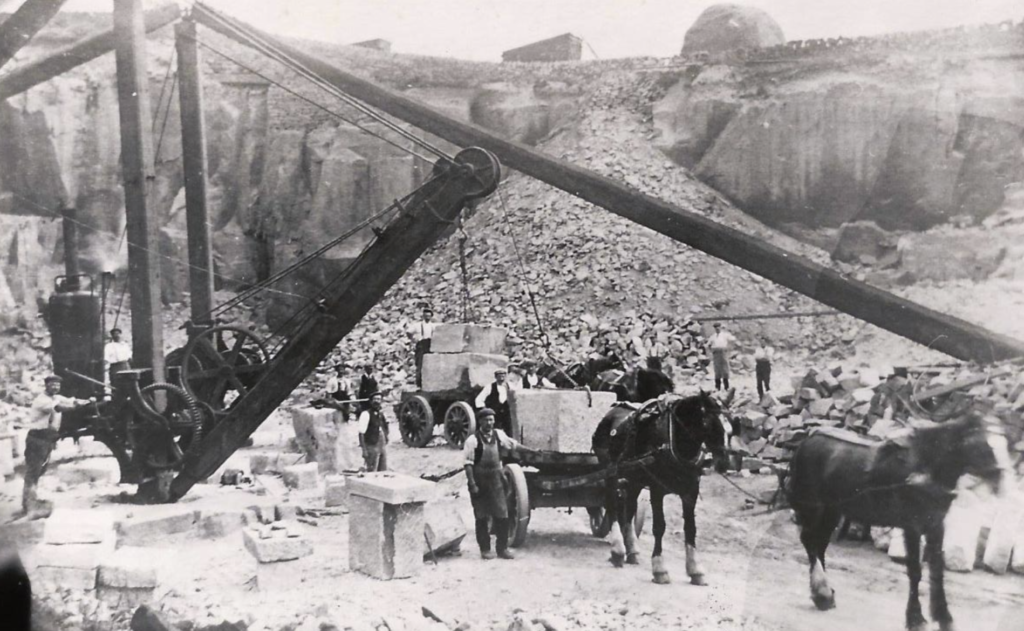
A website called “Valley of Stone‘ outlines the life of a nineteenth century stone delver in Lancashire, which would have been very similar to that of a worker in Bramley. It describes how every day hundreds of quarrymen would set off to work. Their jackets, waistcoats and trousers would be made of heavy moleskin or corduroy to keep out the wind with a simple knotted neckerchief, that was often useful as a bandage for slight injuries or wiping their sweating brow. In their group photos they are often seen with a determined countenance smoking a clay pipe. They wore iron shod clogs on their feet and in their hands would be their brew can and food for the day.
The men worked with hand tools with no safety equipment, using only hammers, picks, crow bars and sledge hammers, forcing the stone from the rock beds. Imagine the effort of swinging a large sledge hammer all day, it was often said that ‘you would never see an overweight quarryman’, and the hard physical labour ensured that was the case.
If the men were lucky enough to avoid being killed or maimed due to accidents in the quarry there was also the distinct possibility that they would develop silicosis, a serious lung disease due to the silica content of the rock. Silicosis can lead to shortness of breath, fever and eventually death.
Robin Pearson wrote the following description of the Bramley quarries in his 1986 PhD dissertation:
Bramley Fall stone had a reputation for excellence dating back to the building of Kirkstall Abbey, and quarrying was recorded in Armley in 1324 . Park quarries at Hough end had produced stone for paving and road making since the early eighteenth century. By 1823 at least 23 quarries in Bramley employed more than 60 getters. As cottages were built, new roads and footpaths laid, highways improved and walls repaired, the demand for stone increased. Numerous small contractors appeared who bought stone in modest quantities to transport by cart to their workplace. The Armley highway surveyors between June 1859 and March 1861 used 15 different contractors, mostly local men, several illiterate, who supplied nearly 1000 tonnes of bluestone, 620 yards of edging, 443 yards of flags and a two and a half ton road roller to build four new roads and a bridge at an estimated cost of £211. Large quantities were moved by canal and several Bramley quarry owners had wharves near Kirkstall.
THE INDUSTRIAL SUBURBS OF LEEDS IN THE NINETEENTH CENTURY: COMMUNITY CONSCIOUSNESS AMONG THE SOCIAL CLASSES – Robin Pearson, University of Leeds, School of Economic and Social Studies.
It was a tough life – but it was a job on which so much of the country’s infrastructure depended on, both then, and now.