

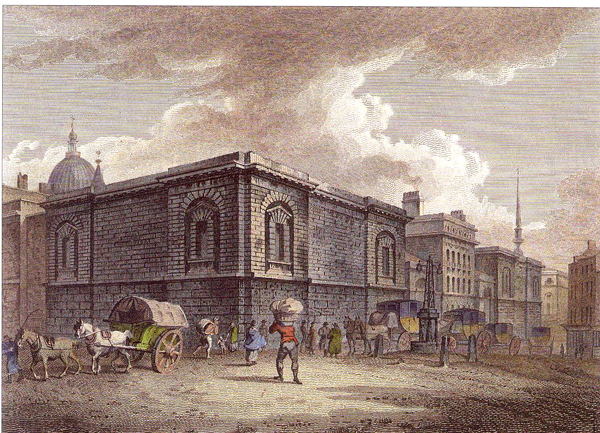
Great-grandfather Jonathan Beard came a cropper with an accusation of forgery – he went to court and ended up in London’s notorious Newgate Jail
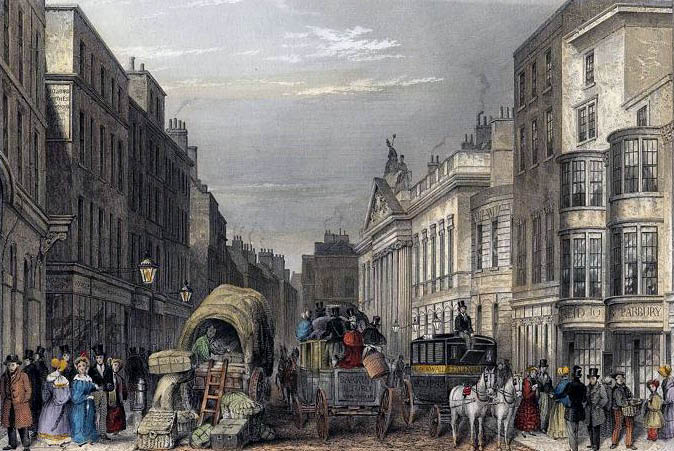
In 1871, Jonathan was running a Coffee Shop in Leadenhall Street in London. It would have been a very busy street at the time, and Jonathan’s father Joseph Guyer Beard had been a successful baker and business owner. Leadenhall Street has always been a centre of commerce. It connected the medieval market of Leaden Hall with Aldgate, the eastern gate in the Roman city wall. The East India Company had its headquarters there, as later did the Peninsular and Oriental Steam Navigation Company (later to be better known as P&O). But while it should have been a plum location for a coffee shop, it did not go according to plan.
In 1871, Jonathan had to declare his business had gone bankrupt.
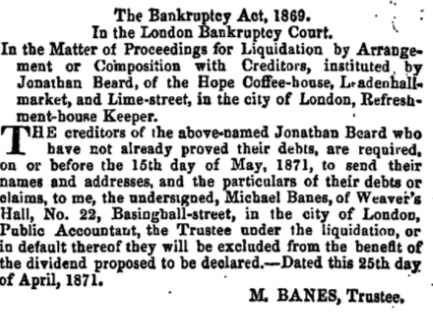
It would have been a difficult time for Jonathan. Both of his parents had died a few years earlier (Joseph in 1866, Sophia in 1868. A few months after Sophia died, Jonathan got married to Julia Lemaire. His brother Joseph James died in 1870, and in the same year, his first son Jonathan was born. In January 1871, his second son, Augustus was born. And then in April, disaster struck.
n the Victorian Era, bankruptcy was a criminal offence and bankrupts were seen as crooks who deserved to be punished. It brought disgrace and humiliation to the individuals concerned as well as to their families and friends. To a young man with a growing family, it was nothing short of a disaster.
So, while the records give no clue as to his state of mind, the next crisis in Jonathan’s life is, perhaps, understandable (even if it’s indefensible.
He forged a cheque, and got found out.
The Old Bailey Court record records, very briefly, that he ‘uttered a a forged order for the payment of 50 shillings with intent t defraud’. He was sentenced to 18 months in Newgate Prison.

Built in the 12th century and demolished in 1904, Newgate prison was extended and rebuilt many times, and remained in use for over 700 years, from 1188 to 1902. For much of its history, a succession of criminal courtrooms were attached to the prison, commonly referred to as the “Old Bailey”. The present Old Bailey (officially, Central Criminal Court) now occupies much of the site of the prison.
50 shillings would be worth around £400 today – an amount which would have been more than enough to see Jonathan sentenced to transportation to Australia (you could be transported for stealing as little as one shilling). Historian James Jupp compares the colonial-era offences of forgery and embezzlement to the equivalent of today’s white-collar crimes. The convicts who committed such crimes tended to be more educated and skilled than the average working convict, and often found work in the colonial civil service. Ironically, of course, his great grandson (me!) is now resident in New South Wales.
But it was to be Newgate Prison for him. Up to 1877, Newgate was the principal prison for London and Middlesex and housed all manner of prisoners of both sexes, including those remanded in custody and prisoners awaiting transportation or execution and those imprisoned for debt. For over 600 years the prison was renowned for its appalling conditions. It was said that the prison was so dirty and squalid that the floors crunched as you walked due to all of the lice and bedbugs. Prison reformers – including the famous Elizabeth Fry – campaigned for an improvement in conditions in the first half of the nineteenth century.
Charles Dickens recorded this mid-18th century account of the conditions in which Jonathan would have been incarcerated:
They are provided, like the wards on the women’s side, with mats and rugs, which are disposed of in the same manner during the day; the only very striking difference between their appearance and that of the wards inhabited by the females, is the utter absence of any employment. Huddled together on two opposite forms, by the fireside, sit twenty men perhaps; here, a boy in livery; there, a man in a rough great-coat and top-boots; farther on, a desperate-looking fellow in his shirt-sleeves, with an old Scotch cap upon his shaggy head; near him again, a tall ruffian, in a smock-frock; next to him, a miserable being of distressed appearance, with his head resting on his hand; – all alike in one respect, all idle and listless.
Charles Dickens, Sketches by Boz, 1836
Jonathan was released, and he and Julia had two more children with a couple of years – including our grandfather, Percy.