

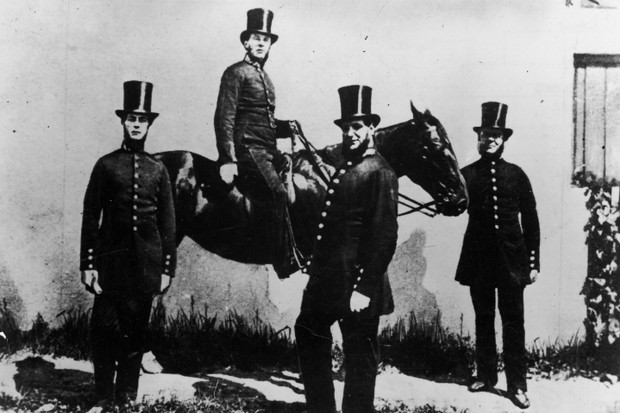
Annette’s third-great uncle John Glayzer
London’s Metropolitan Police Service was formed in 1829, the first modern police force in England – and Annette’s third great uncle John Glayzer became a ‘Bobby’ in November, 1857.
Due to public fears concerning the deployment of the military in domestic matters, Sir Robert Peel had organised the force along civilian lines. To appear neutral, the uniform was deliberately manufactured in blue, rather than red which was then a military colour, along with the officers being armed only with a wooden truncheon, along with a rattle to signal tfor help.
John was born in Dymchurch on the Kent coast, in 1833, to Edward and Jane Glayzer. Edward was an agricultural labourer, but died when John was only 14. Three years later, Jane was listed in the Census as being a ‘pauper’, so perhaps it wasn’t surprising that John left for London after toiling as an agricultural labourer himself. His name is spelled variously ‘Glayzer’, ‘Glazer’ and ‘Glazier’.
When John signed up at Scotland Yard in 1857 at the age of 24, police officers wore top hats, to complete the civilian look. That didn’t change until 1864, when a version of the police helmet that we are more used to was introduced (officially called a ‘custodian helmet’).
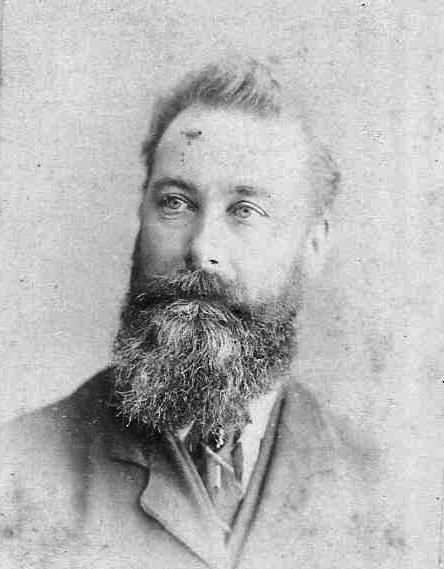
The original standard wage for a police constable was one guinea a week – that’s £1.05, but worth around £128 in today’s money. Recruitment criteria required applicants to be under the age of 35, in good health, and to be at least 1.70 metres tall. Working shifts lasted 12 hours, 6 days a week, with Sunday as a rest day.
John was based in Paddington, which in the 1860s was seen as a gateway to the capital, thanks to the newly built Paddington Railway station, and the canal network that went through the area. The police station continued in Hermitage Street south of the almshouses until 1864, when a new one was built on the north side of Dudley Grove, later no. 62 Harrow Road. Called Paddington Green police station, it survived as part of Paddington and, by 1942, Marylebone divisions and formed a setting for the film ‘The Blue Lamp’. The building contained married quarters, converted to single rooms in 1887. It was demolished as part of the road improvements for Westway after the opening of a station at the north corner of Harrow and Edgware roads in 1971.
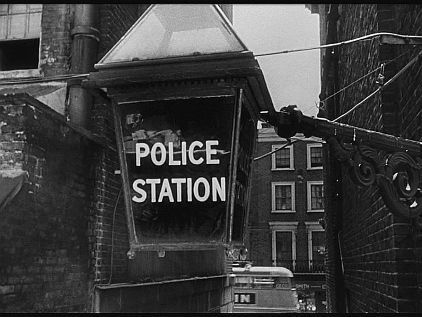
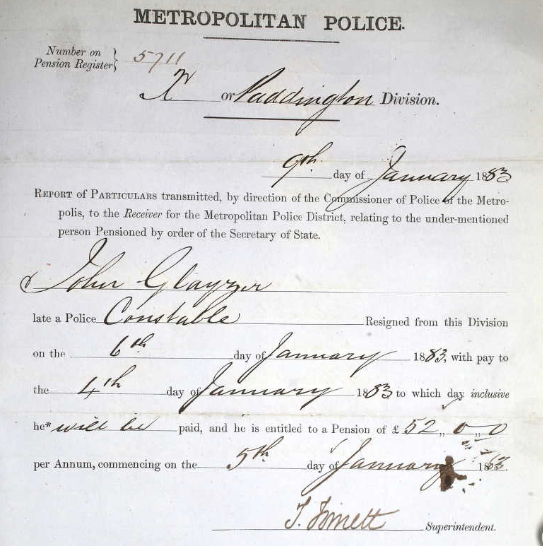
John remained police officer until January 1883, when he retired on a pension of £52 a year.
He moved back to the area where he was born, on Kent’s south coast at Dymchurch. In this photo, he is seen on the beach at Dungeness, in front of the fourth Dungeness lighthouse, which was completed in 1984. He certainly looks comfortably well off.
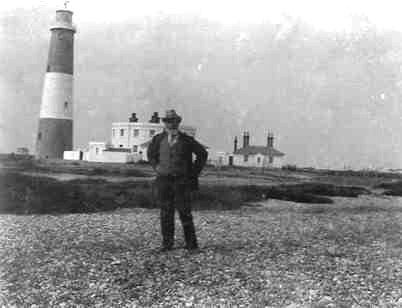
John died in 1914 back in Dymchurch, leaving all his estate to his wife and his three children. By then, Joe, the eldest had emigrated to Canada (in 1908). The middle son, also named John, emigrated earlier than that to New Orleans in the United States at the age of 17 in 1885. The youngest son, George, had also displayed a wanderlust, joining the Royal Navy at the age of 15 in 1889, serving in China and the East Indies, eventually spending some time as a civilian in Yokohama, Japan, from 1913. But that is another story.