

Adapted from an article written by Diana Rapaport for the website American Ancestors
11th Great Grand-uncle James Elliott Paterson – a Scot – may have been the son of the Bishop of Ross but that didn’t stop him ending up as an indentured servant to English colonists in the New World.
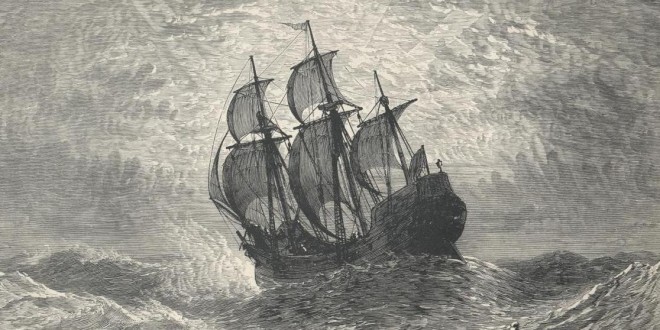
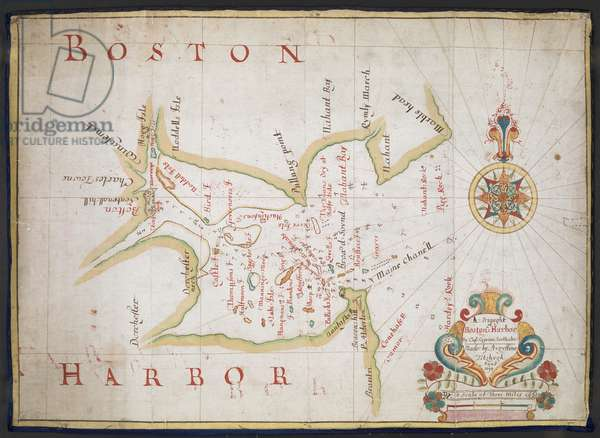
Three hundred fifty years ago, in 1652, Captain John Greene anchored his ship the John and Sara in Boston Harbor after a long winter crossing of the North Atlantic. Below decks he carried trade goods from London — “ironworke,” “household stuffe & other provisions for Planters” — but most of the cargo space was packed with human freight. On that voyage, the John and Sara was little more than a slave ship, transporting nearly 300 “scotch prisoners” from the Battle of Worcester, where Oliver Cromwell’s Parliamentary forces had crushed the royalist army of young Charles II and ended the English Civil War.
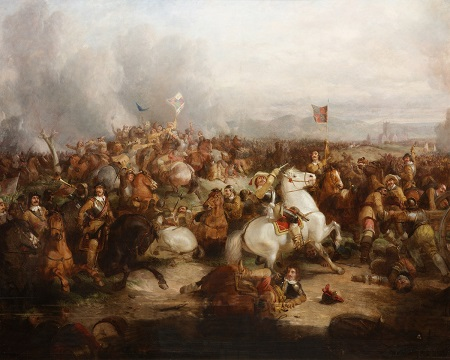
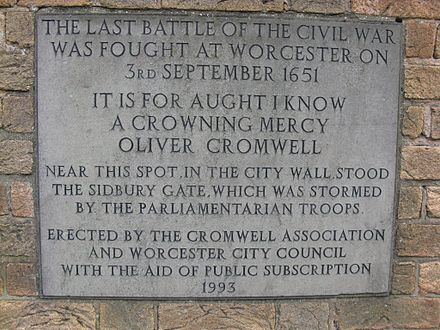
These Scotsmen, many of them Highlanders pressed into service by their clan chiefs and lairds, had never expected to see England, much less travel across the Atlantic Ocean to a distant English colony. For weeks over the previous spring and summer, their ragtag royalist army had defended Scotland and the newly-crowned King Charles II against Cromwell’s invading troops. While the Scots army aimed to avoid conquest by England, King Charles hoped to regain the English crown, and he pushed the royalist Scots south across the border and headed towards London. Cromwell pursued, and an expected uprising of royalist support never materialized. Finally, outnumbered, exhausted and running out of supplies, the royalists stopped at the city of Worcester. There, King Charles watched from the cathedral tower as Cromwell’s army prepared for the coming battle. Cromwell’s attack came early on September 3, 1651. At the end of the day, after bitter hand-to-hand fighting in the city streets, up to 4,000 Scots lay dead; 10,000 more were captured, with minimal casualties on Cromwell’s side. The King escaped to exile in France.
Few of the Scots who survived Worcester ever returned home. Thousands of prisoners were “driven like cattle” to London. As one witness described the convoy, “all of them [were] stript, many of them cutt, some without stockings or shoes and scarce so much left upon them as to cover their nakedness, eating peas and handfuls of straw in their hands which they had pulled upon the fields as they passed.” At temporary prison camps in London and other cities, many prisoners died of starvation, disease and infection, while the Council of State debated what to do with the defeated multitudes. A thousand prisoners were put to work draining the fens in East Anglia; 1500 shipped out to the gold mines of Guinea; others were sent to labor in the Barbadoes and Virginia; and in November, 272 Scots were herded aboard the John and Sara, bound for New England.
We know their names, or at least the phonetic equivalents. A London scribe penned a list before the ship left port, and he must have strained to comprehend unfamiliar names and dialects, judging from creative entries such as “Murtle Mackjlude,” “Origlais Mackfarson,” “Almister Mackalinsten,” etc. We know that the Scots were fated for sale as indentured servants, consigned to Charlestown merchant Thomas Kemble, who had instructions to dispose of the men to “best Advantage” and to invest the proceeds in merchandise for the “Barbadoes” market We know that a similar shipload of 150 Scots war prisoners, arriving in Boston on the Unity a year earlier, ended up laboring at the Massachusetts ironworks and at sawmills in Maine.
No systematic effort has been made, however, to trace what happened to the Scots from the John and Sara, and most of their stories are lost to history. Tantalizing scraps of evidence remain. Court and probate records, land deeds, local town histories, and genealogies of New England families still offer clues about how some of the war prisoners adjusted to exile.
As “Scotchmen,” they occupied a distinctly inferior rung of the social ladder, ranked with “Negroes” and “Indians” in various laws passed by the General Court. Scots were not only defeated enemies; they were foreigners who spoke a strange language (Gaelic, or a heavily-accented Scots English), and their religious leanings were suspect (Presbyterian, if not outright papist Catholic). They could not have felt entirely welcome in Puritan Massachusetts, despite the demand for servants in a labor-scarce economy.
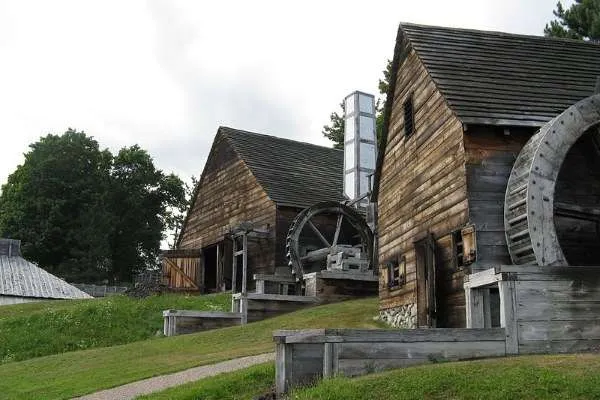
About 50 went to the Saugus Iron Works, the first successful iron works in the colonies. It produced much-needed iron bars for tools, building materials and cooking implements. The Scottish POWs worked 12-hour days at hard, dangerous labor. They worked as woodcutters to supply the wood to make charcoal, or as forge hands, as blacksmiths, as miners and farmhands.
James Paterson (listed as Pattison)was about 19 years old when the John and Sara brought him to New England. No record of his indenture has been located, but he apparently had settled in Billerica by 1658 (his name generally spelled “Paterson” or “Patterson” in the extant records). In 1662, he married a member of the Cambridge church congregation, Rebecca Stevenson, who happened to be the daughter of the prison master, Andrew Stevenson.
Not long after their marriage, James was convicted of “provoking his wife to her great afflicon & sorrow & trouble of the Towne, by his unworthy and unjust jealousies of her…” His conduct must have been reprehensible, even by 17th Century standards, since he was ordered to post a bond in the sizeable sum of forty pounds (despite Rebecca’s petition for leniency), and he was “sent to ye house of correccon.” At the next judicial session in 1663, he still had not “approved himself to cary it well towards his wife,” and the Court refused to release his bond.
James and Rebecca must have resolved this conflict and become respected members of the Billerica community, for Rebecca transferred her church membership there in 1667, and by 1690 James was made a freeman, giving him full voting rights. They had two daughters and six sons, including Andrew, who “went to sea and never returned,” and Joseph, a Watertown tailor. James died at Billerica on July 14, 1701.
James Paterson was listed as one of the colonist who took part in the fighting to put down the Indian uprising know as King Phillip’s [Indian] War circa 1675 to 1676. Many of his descendants used the spelling of Patterson and fought during the American Revolution and helped settle the interior of New York State as part of the “Boston Purchase” also referred to the “Ten Townships Purchase” in Tioga, Tompkins and Broome Counties in NY.
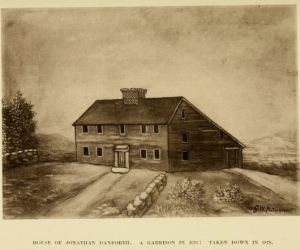
One of Billerica’s most famous families was the Danforth family. Captain Jonathan Danforth was one of the most influential surveyors in the Merrimack River Valley and its lower tributaries (in Massachusetts and New Hampshire) of the late 1600s and early 1700s. His elder brother, Thomas, had a long career in public service, holding positions in the Massachusetts legislature and as president of the Province of Maine. In his final years, he was an associate justice of the Massachusetts Superior Court. Notably, he served as a judge during the Salem witch trials of 1692 – though he is inaccurately depicted in Arthur Miller’s 1953 play The Crucible and its movie adaptations as doing so. He is presented as a harsh and domineering governor, though in reality, Danforth is recorded as being critical of the conduct of the trials, and actually played a role in bringing them to an end.
If you’re interested to find out more about what happened to the Scottish Prisoners of War following the battle of Worcester, there’s heaps of information on a website run by the Scottish Prisoners of War Society, SPOWS.