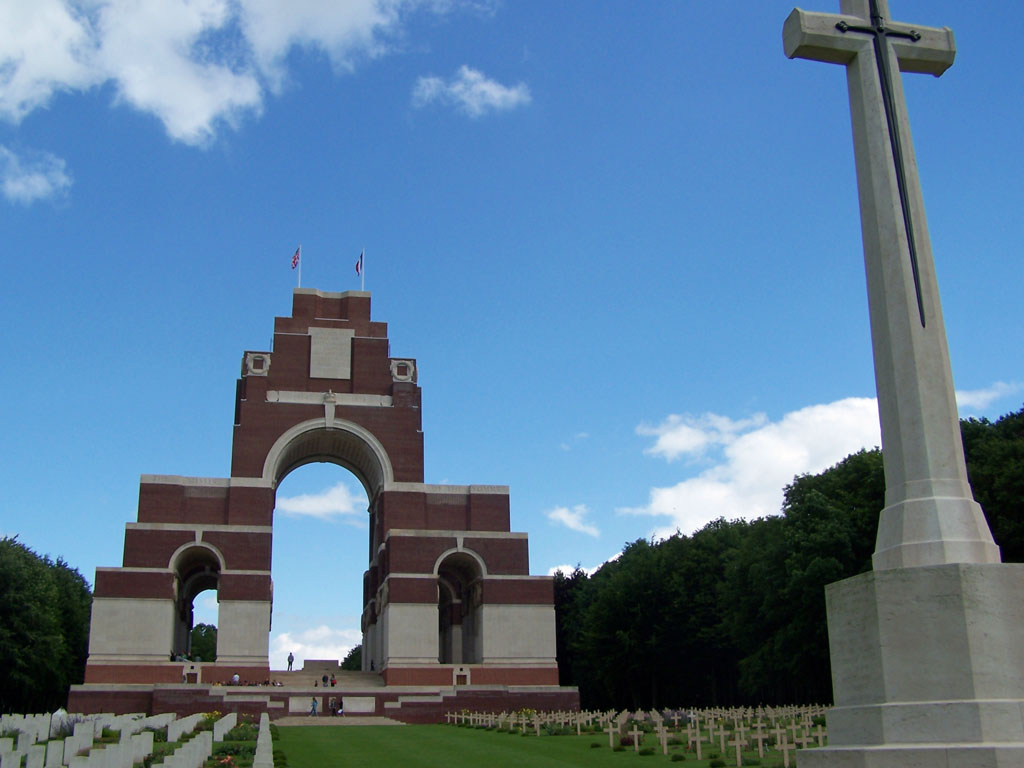

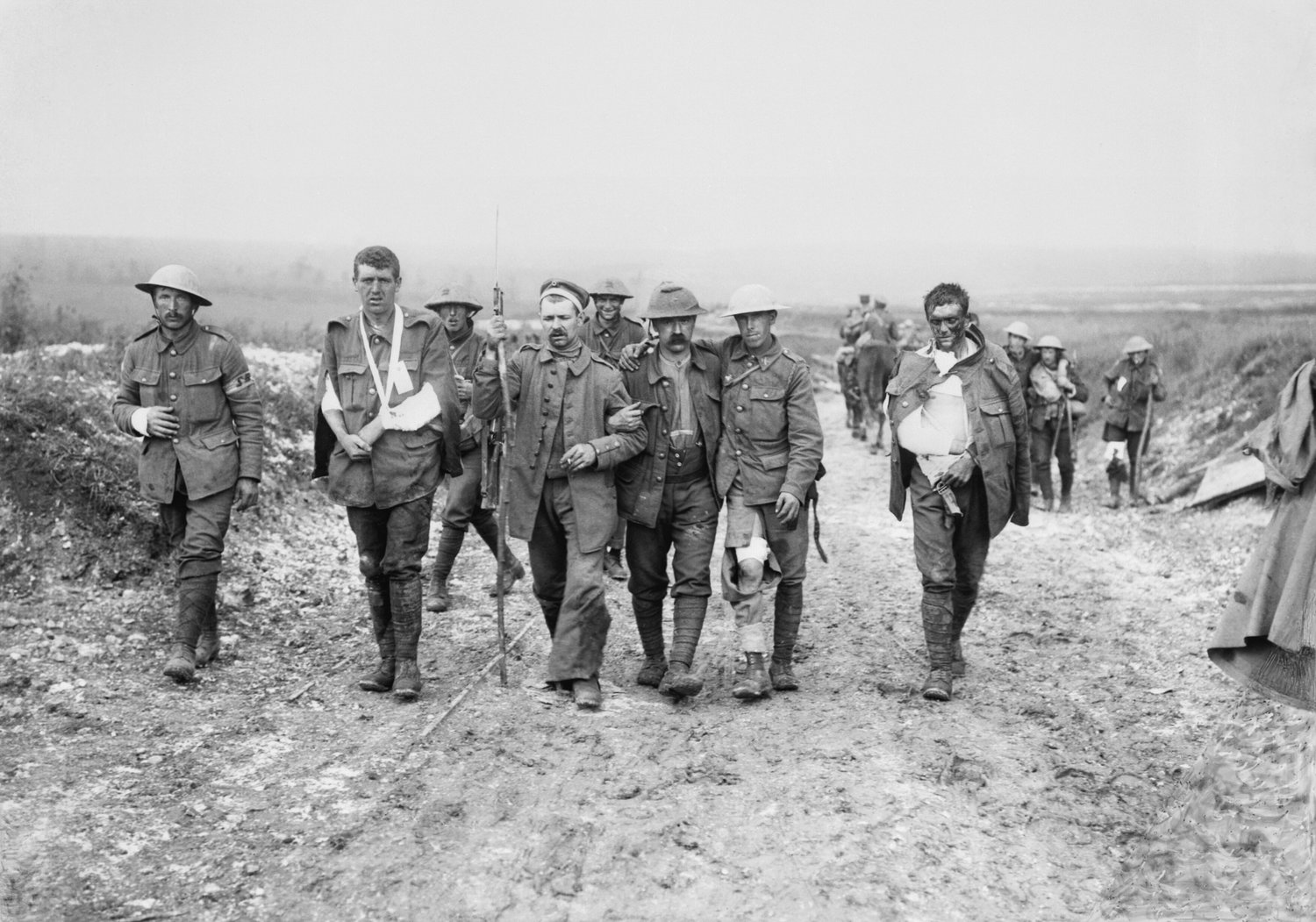
Great-Grand Uncle George William Pemberton had an erratic career with the British Army. In 1901 he was jailed for desertion – but 15 years later he was back in uniform, and lost his life at the battle of Thiepval in the Somme during World War 1.
George was born in Easingwold in Yorkshire in 1881, to John and Mary Jane Pemberton. John was an agricultural worker, and they lived at 97 Long Street in Easingwold. That property was recently for sale and described by the real estate agent as a ‘substantial property’.
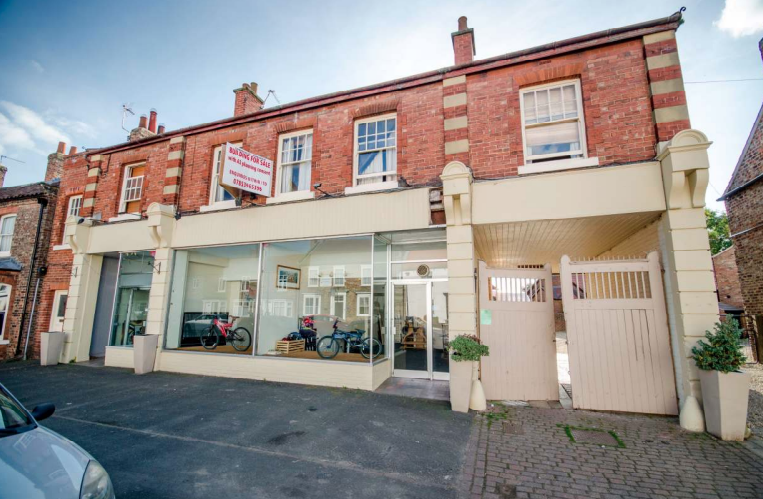
The current property has been knocked through to next door so is twice the size it was in George’s day.
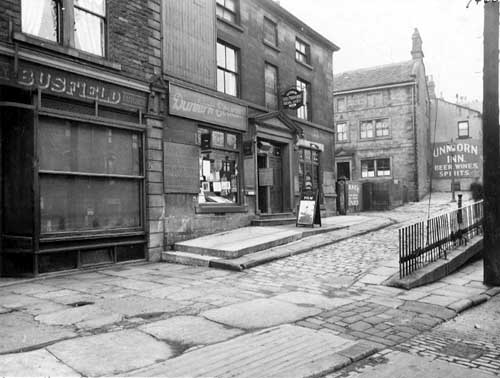
Ten years later, they’d moved to Bramley, a suburb in western Leeds, a village which was rapidly being swallowed up by the westward expansion of the city. But by the time of the next census in 1901, when George was just 20, things had not turned out so well. He was in Prison.
The timeline is a little confusing but it appears he had joined the army – the Royal Marine Artilley – in July 1900. By October he had been ‘discharged with ignominy’ with a character reference listed as ‘bad’. By the time of the census in 1901, he was in prison – presumably as a result of whatever incident got him discharged. He was in Winchester Prison in the parish of St Faith Within in Winchester. He appears in prison records in Dublin in 1902, where he was charged with desertion from the Army. Quite how he ended up in Kilmainham Prison isn’t clear but the prison records show a number of other military prisoner at the time. The jail itself was notorious as a site of oppression and suffering and in later years become infamous as the prison where many of those fighting for Irish independence ended up, including Eamon de Valera who later became the Irish Republic’s Head of State.
But the stay in prison was relatively short and by Christmas 1906, George was back in Bramley, working as a market gardener, and on Christmas Day itself, he married Maria Raistrick, who was four years younger than him.
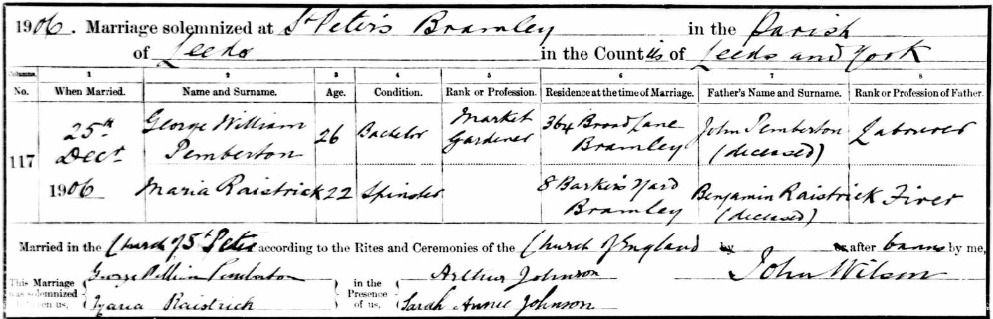
They were living in Broad Lane, Bramley. He was working as a carter and carting agent by the time of the 1911 Census, which found him staying with his brother in Elder Road, Bramley.
But in just a few years, the Great War broke out and George re-enlisted, this time with the 1st 8th Battalion of Prince of Wales’s Own (West Yorkshire) Regiment. He found himself fighting in France and in Flanders, and was at Thiepval on the Somme, one of the fortress villages that was held by the Germans in 1916. Thiepval village was destroyed by the bombardment, except for one part of the chateau (the ruins of which contained machine gun nests). The houses in the village, although flattened, had deep cellars where the Germans held out, and their machine gun posts were not destroyed by the bombardment. July 1st 1916 at Thiepval was the beginning of the Battle of the Somme.
On 1 July 1916, supported by a French attack to the south, thirteen divisions of Commonwealth forces launched an offensive on a line from north of Gommecourt to Maricourt. Despite a preliminary bombardment lasting seven days, the German defences were barely touched and the attack met unexpectedly fierce resistance. Losses were catastrophic and with only minimal advances on the southern flank, the initial attack was a failure. In the following weeks, huge resources of manpower and equipment were deployed in an attempt to exploit the modest successes of the first day. However, the German Army resisted tenaciously and repeated attacks and counter attacks meant a major battle for every village, copse and farmhouse gained.
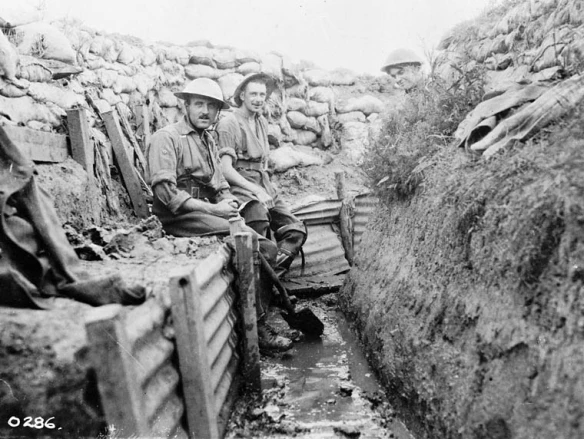
Conditions in the trenches were grim. Grim, but often boring. In Diana Overbey’s excellent blog ‘Presently in the Past’ she quotes British soldier George Coppard’s description of a typical day.
Breakfast over, there was not long to wait before an officer appeared with details of the duties and fatigues to be performed. Weapon cleaning and inspection, always a prime task, would soon be followed by pick and shovel work. Trench maintenance was constant, a job without end. Owing to the weather or enemy action, trenches required repairing, deepening, widening and strengthening, while new support trenches always seemed to be wanted
“Presently in the Past – Diana Overbey
Trenches were long, narrow ditches dug into the ground where soldiers lived. They were very muddy, uncomfortable and the toilets overflowed. These conditions caused some soldiers to develop a problem called trench foot. There were many lines of German trenches on one side and many lines of Allied trenches on the other.
At the end of September, Thiepval was finally captured. The village had been an original objective of 1 July. But George never got to see that – he had been killed on 13 August.
His name is one of more than 72,000 officers and men of the United Kingdom and South African forces who died in the Somme sector before 20 March 1918 and who have no known grave. Over 90% of those commemorated died between July and November 1916. The memorial also serves as an Anglo-French Battle Memorial in recognition of the joint nature of the 1916 offensive and a small cemetery containing equal numbers of Commonwealth and French graves lies at the foot of the memorial.