

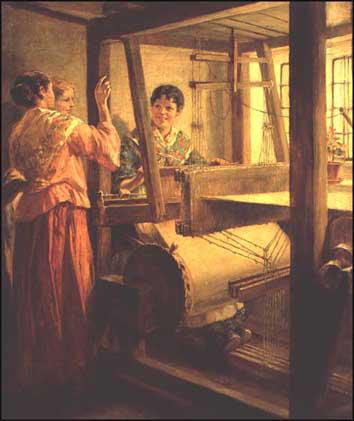
Fifth great grandfather Richard Burton was a cotton handloom weaver, living in Wheelton in Lancashire. In the 1851 census he was in his 70s, and the era of the home-based handloom weaver was on its last legs thanks to the Industrial revolution and the growth of factory production. But in his younger days, being a handloom weaver was a very worthwhile occupation.
Although the weavers were not a wealthy class of people, there were advantages to ‘working from home’ as opposed to being at the beck and call of the factory clocks. The industry had been regulated by Craft and Trade Guilds since medieval times, effectively creating a ‘closed shop’ that required would-be weavers to serve an apprenticeship. The guilds also set standardised prices for the cloth. Living conditions were also comparatively decent as their homes initially tended to be located away from the worsening pollution of town centres.
In the late 18th century, these weavers were in a powerful position because although recent technological advances had mechanised cotton spinning operations, nobody had yet invented a satisfactory power loom. This created a surplus of spun cotton and a production bottleneck that the weavers were able to exploit. They were guaranteed a constant supply of yarn, full employment and high wages. During the 1790s, handloom weavers in Bolton could earn up to £1 10s a week – a large sum in those days.
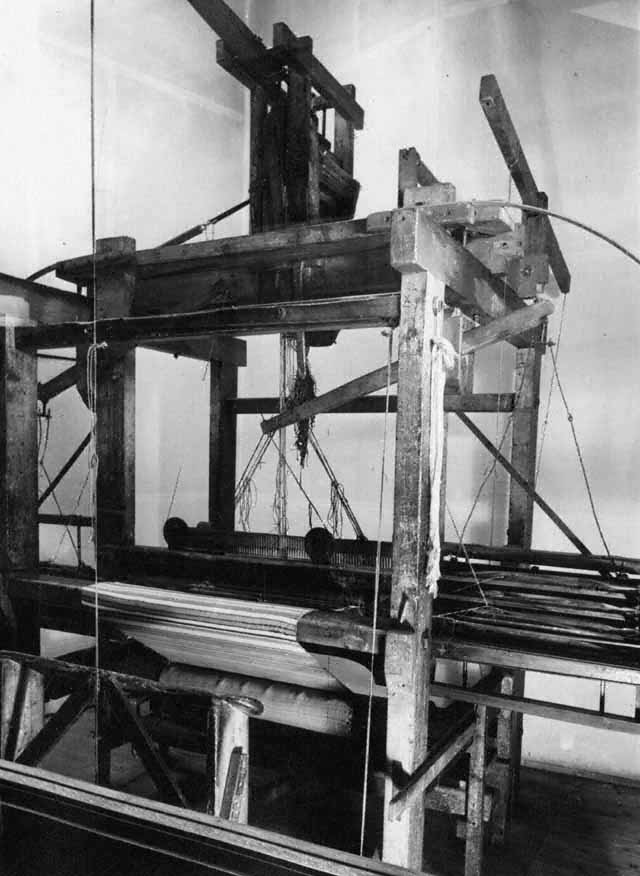
The handloom was devised about 2,000 years ago and was brought to England by the Romans. A handloom consisted of four wooden uprights joined at top and bottom to form a box-like framework. There were wooden rollers between both pair of uprights, one for the warp and one to collect the cloth. The weaving operation consisted of sending the shuttle containing the weft back and forth through the threads of the warp. A device operated by a treadle lifted and lowered alternate threads and a lathe hung from the top of the loom enabled the weaver to push each thread of weft up against the cloth already woven.
Before weaving could begin the warp had to be wound on to its roller, or beam, and the threads passed through the lathe and fastened to the cloth beam. The warp threads had to be dressed with flour and water paste to make them strong enough to withstand the weaving process.
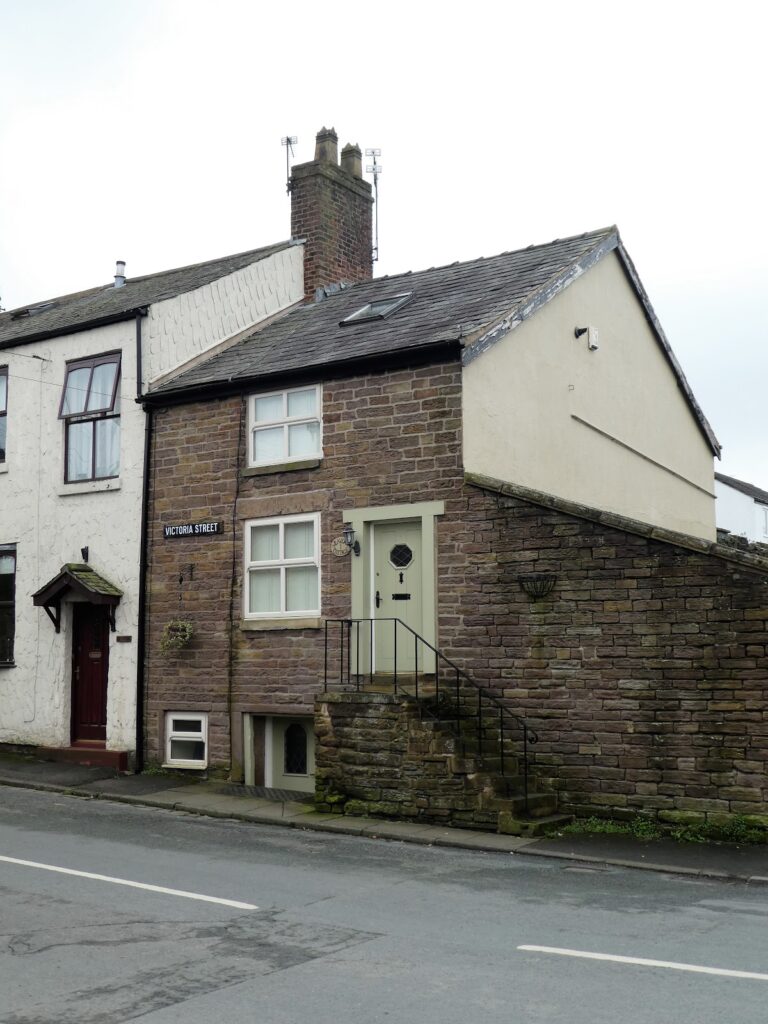
The handloom became an essential item of household furniture, and its influence on house design can be seen in parts of Lancashire to this day. The cottages either had the handlooms in the basement, the entrance to the living quarters up two or three steps, and a long row of windows alongside, to give light for working the loom, or in an upper room, in which the windows ran full length of the cottage.
The ‘golden age’ of the independent handloom weaver lasted roughly from 1790 to 1812. For most of this period entire families were involved with the trade. Many men who had once worked the land turned to weaving, and immediately prospered. With a four- day week, high status as skilled craftsmen, and a wage that allowed them to live in comfort, the weavers were the elite of the burgeoning working class. However, things were changing. Almost from the start of this period a series of inventions followed one upon the other that at first assisted the weavers, allowing for the production of larger quantities of finished cloth. Ultimately, of course, these innovations would actually lead to the destruction of the weavers way of life.
In 1785 Cartwright invented a weaving machine that could be operated by horse power, a waterwheel, or a steam engine, and he began using these looms in a Manchester mill. They enabled unskilled boys to weave three and a half pieces of material in the time it took a skilled weaver using traditional methods to weave just one. The rise of the power loom was gradual but inevitable. As demand for cloth increased, a flood of new workers (particularly Irish immigrants) entered the weaving trade, resulting in an oversupply of labour that caused wages to fall. There had been approximately 75,000 handloom weavers in Britain in 1795. This grew to more than 200,000 by 1812, when there was a burgeoning number of power-loom factories. The number of town weavers increased and their characteristic three-storey weavers’ cottages were built in larger numbers. Ultimately, of course, these innovations would actually lead to the destruction of the weavers way of life.
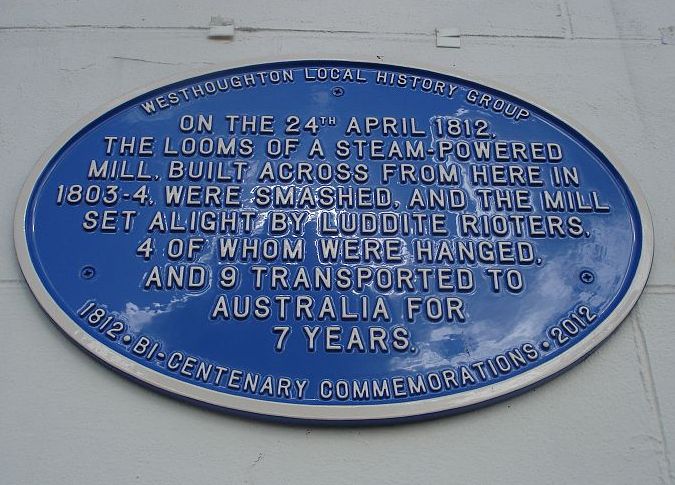
On Friday April 24th 1812 a mob 60-100 strong attacked the mill of Thomas Rowe and James Duncough at West Houghton. Trouble had been expected for some time and the military had maintained a presence at the mill for much of the week. However, by Friday they had gone and the mill, which housed 180 powerlooms, was left undefended except for 12 workers armed with borrowed guns. At about 4 p.m. the mob arrived at the mill. The Superintendent, Joseph Kay, rode to Bolton to fetch help, but by the time he returned the mill had been destroyed. The events had been witnessed by many workers and people who lived nearby, and this was to prove crucial when the cases came to trial. The event is commemorated today:
Although machine-breaking was a capital offence, rio//ts and loom-smashing continued that year, and four men were killed at Middleton during rioting there. In 1817, hundreds of weavers, carrying blankets to sleep in, set off on the ‘Blanketeers March’ from Manchester to petition the Prince Regent against political repression. More than 200 had been arrested, and the rest dispersed by the time they reached Macclesfield.
By the mid-century, handloom weaving was clearly a dying industry. The Radical Peter Murray McDouall wrote in his Chartist and Republican Journal in 1841 that the rise of the factory system under industrial capitalism had created wage slavery and, as seen with the ongoing disappearance of the weavers, destroyed ‘independence, family economy and control over the pace and nature of work’.