

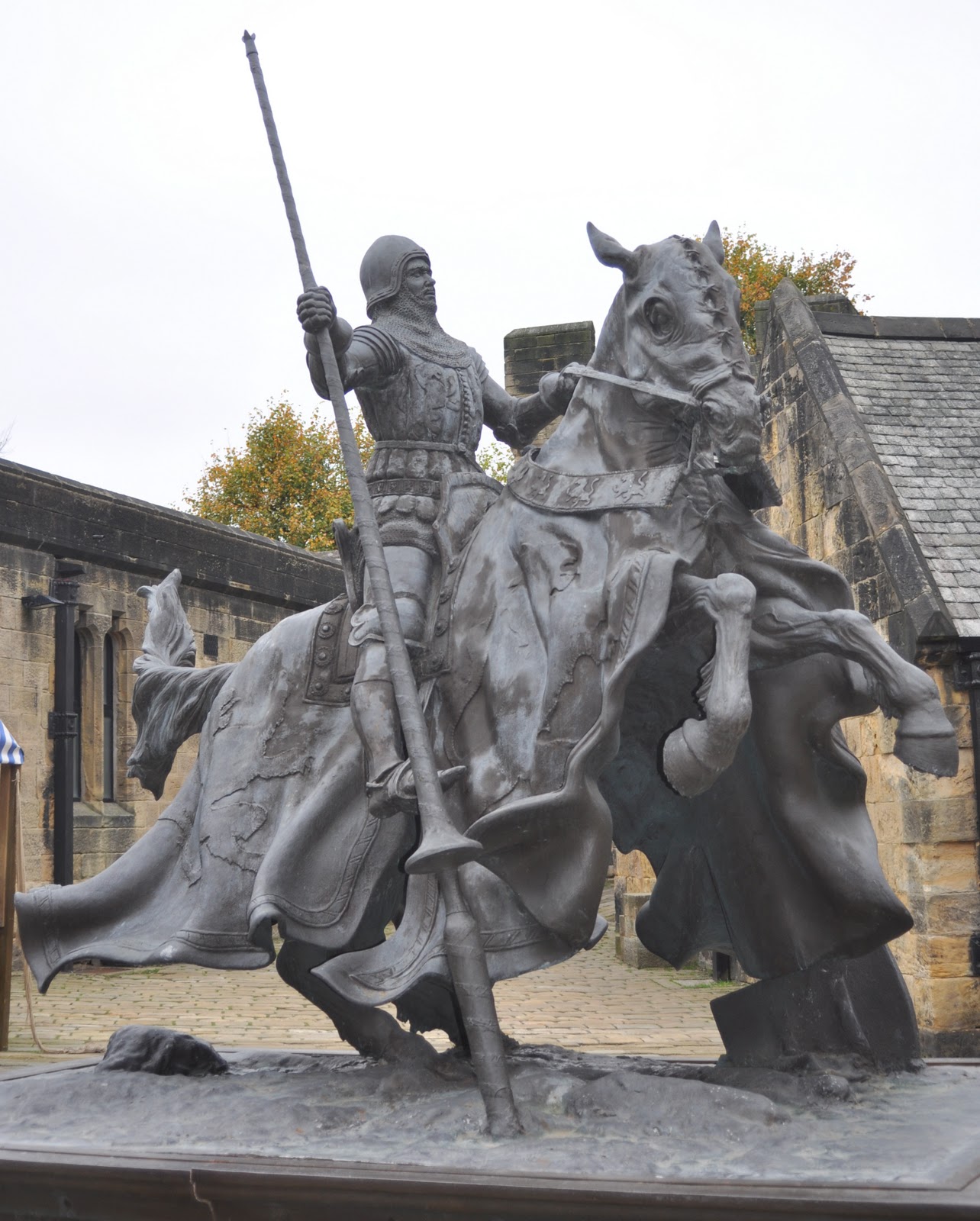
Henry Percy, ‘Hotspur’, is one of Shakespeare’s best-known characters. And he’s our 19th Great Grandfather.
Henry Percy was born 20 May 1364 at either Alnwick Castle or Warkworth Castle in Northumberland, the eldest son of Henry Percy, 1st Earl of Northumberland, and Margaret Neville, daughter of Ralph de Neville, 2nd Lord Neville of Raby, and Alice de Audley.He was knighted by King Edward III in April 1377, together with the future Kings Richard II and Henry IV.
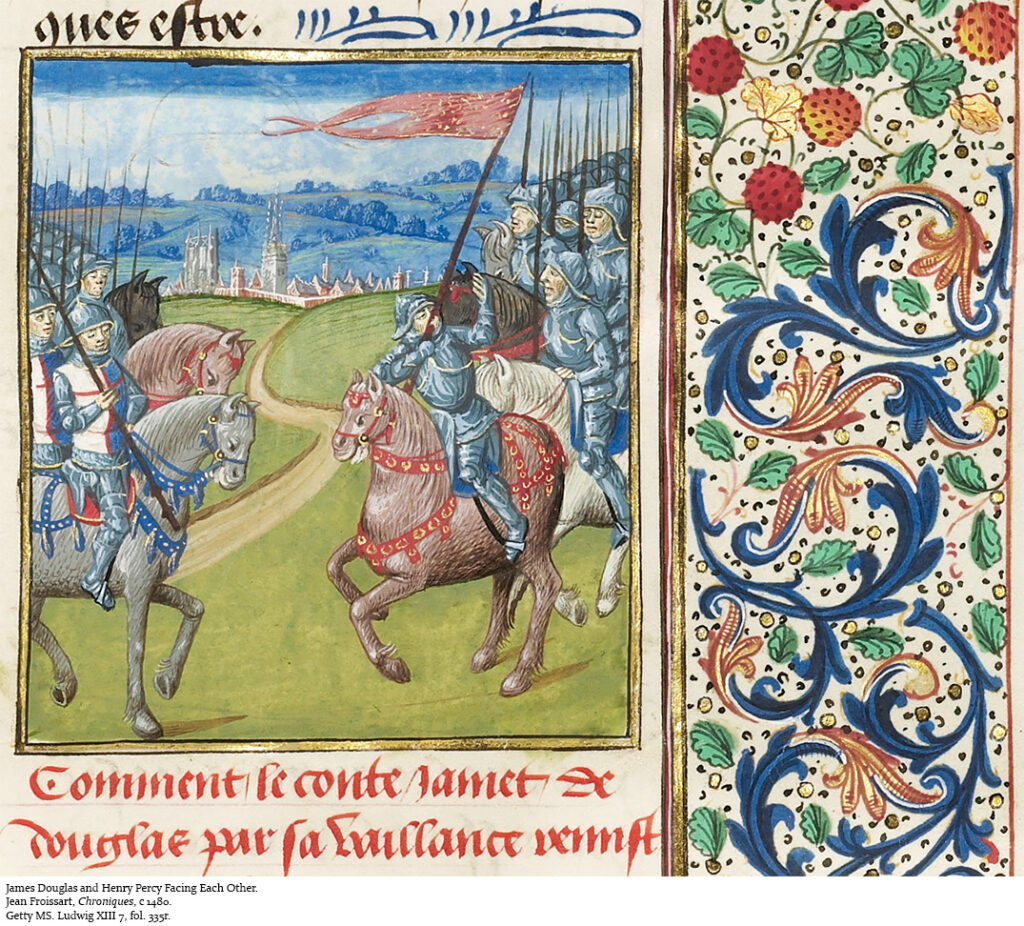
As a tribute to his speed in advance and readiness to attack” on the Scottish borders, the Scots bestowed on him the name ‘Haatspore’. In April 1386, he was sent to France to reinforce the garrison at Calais and led raids into Picardy. Between August and October 1387, he was in command of a naval force in an attempt to relieve the siege of Brest. In appreciation of these military endeavours he was made a Knight of the Garter in 1388. Reappointed as warden of the east march, he commanded the English forces against James Douglas, 2nd Earl of Douglas, at the Battle of Otterburn on 10 August 1388, where he was captured, but soon ransomed for a fee of 7000 marks.
Percy’s military and diplomatic service brought him substantial royal favour in the form of grants and appointments, but despite this, the Percy family decided to support Henry Bolingbroke, the future Henry IV, in his rebellion against Richard II. On Henry’s return from exile in June 1399, Percy and his father joined his forces at Doncaster and marched south with them. After King Richard’s deposition, Percy and his father were ‘lavishly rewarded’ with lands and offices.
In spite of the favour that Henry IV showed the Percys in many respects, they became increasingly discontented with him. The Percys rebelled in the summer of 1403 and took up arms against the king. According to some historians, it is clear that the Percys were in collusion with the Welsh rebel Glyndŵr. On his return to England shortly after the victory at Homildon Hill, Henry Percy issued proclamations in Cheshire accusing the king of ‘tyrannical government’.
Joined by his uncle, Thomas Percy, Earl of Worcester, Percy marched to Shrewsbury, where he intended to do battle against a force there under the command of the Prince of Wales. The army of his father, however, was slow to move south and it was without the assistance of his father that Henry Percy and Worcester arrived at Shrewsbury on 21 July 1403, where they encountered the king with a large army. The ensuing Battle of Shrewsbury was fierce, with heavy casualties on both sides but, when Henry Percy himself was struck down and killed, his own forces fled.
Henry Percy, ‘Hotspur’, is one of Shakespeare’s best-known characters. In Henry IV, Part 1, Percy is portrayed as the same age as his rival, Prince Hal, by whom he is slain in single combat. In fact, he was 23 years older than Prince Hal, the future King Henry V, who was a youth of 16 at the date of the Battle of Shrewsbury.
The name of one of England’s football clubs, Tottenham Hotspur F.C., acknowledges Henry Percy, whose descendants owned land in the neighbourhood of the club’s first ground in the Tottenham Marshes.
A 4.3 m statue of Henry Percy was unveiled in Alnwick by the Duke of Northumberland in 2010.
Henry “Hotspur” Percy’s notoriety blossomed as one of William Shakespeare’s best-known personalities. Though fact and fiction do not fully meet in Shakespeare’s plays, his ebullient character remains etched in history, partly due to Shakespeare’s writing.