

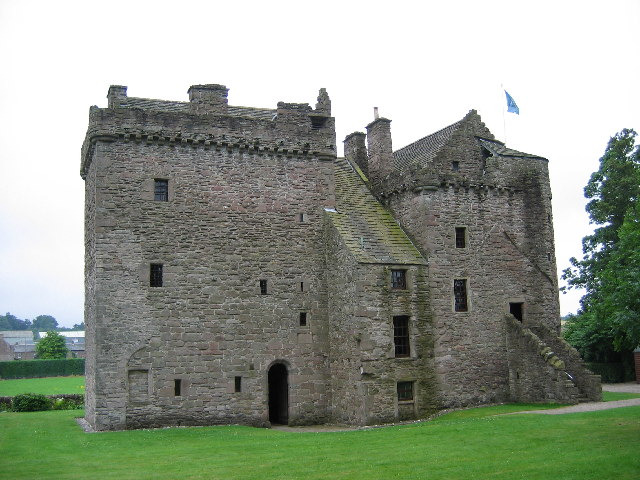
15th Great Grandfather, Sir William Ruthven (1460 -1528)
Sir William Ruthven was the first Lord of Ruthven and the founder of this Scottish line of peerage. He was created Lord Ruthven by James III of Scotland in 1488 when he was 28 years old.
The Ruthven family stretch back long before Sir William was created a Lord of Parliament. The surname is derived from lands in Perthshire. From the similarity of their armorial bearings, some think the family who first bore it in Scotland came originally from Aragon in Spain, bit it’s more likely they derived their descent from Sway, (Suanus,) the son of Thor, a person of Saxon or Danish blood, who settled in Scotland in the reign of David I.

Sir William RuthvenHe held the office of Hereditary Sheriff of Perthshire in 1471 and sat in the Scottish Parliament among the feudal barons as Laird of Ruthven. He held the office of Conservator of a Truce with England in 1484.
James III needed the support of Sir William against rebels who wanted to replace him with his son, James, Duke of Rothesay. James III was not a popular king – he pursued an alliance with the English, he was not seen as administering justice at all fairly, and his relationships with the rest of the family were nothing short of disastrous. He did, however, bring the Islands of Shetland and Orkney from Danish to Scottish rule, by marrying Margaret of Denmark.
On 18th June 1488, Sir William Ruthven joined King James III. at Perth with 3000 troops. The first battle with the Prince’s army was near Blackness Castle. The King was forced to negotiate with his rebels, and handed over Sir William as a hostage, along with others who had supported him. Sir William may have been chosen as a hostage because he was the rival of a one of the rebels, Lord Oliphant, for the office of Sheriff Of Perth. He took no further part personally in the battles, and remained a prisoner until the end of the conflict after the death of James III at the Battle of Sauchiburn. Legend has it that the King had been presented with presented a “great grey horse” that would carry him faster than any other horse into or away from the battle. Unfortunately, the horse threw the King during the battle, and James III was either killed in the fall, or was finished off by enemy soldiers. Sir William was made to pay a ransom of £1000 for his release – a huge sum of money in those days, possibly worth more £830,000 today.

The King didn’t appear to bear a grudge – he granted Lord Ruthven land within a few years and in August 1513, he was invested as a Privy Counsellor of Scotland. The Privy Counsel was a powerful body, supervising the administration of the law, regulating trade and shipping, taking emergency measures against the plague, granting licences to travel, administering oaths of allegiance, banishing beggars and Gypsies, dealing with witches, recusants, Covenanters and Jacobites, and tackling lawlessness in the Highlands and the Border country. Sometime after 1515 he also became one of the guardians of the boy King James V of Scotland who came to the throne in September 1513 at the age of just eighteen months. James was the only legitimate child of James IV to survive infancy.
Lord Ruthven was rumoured to have died sometime after July 1528.