

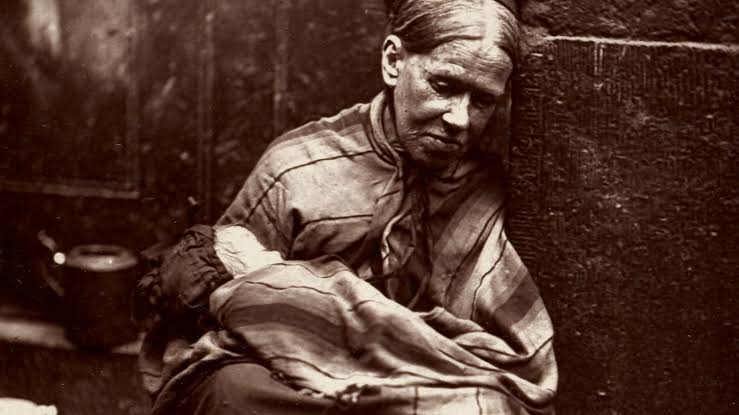
Annette’ s second great uncle and aunt
It was, as they say, grim up north. Or at least, when you were working class in the Midlands anyway. A sad piece of contemporary news has turned up about Annette’s second great uncle and aunt, William and Ellen Hatton, from Castle Gresley. In 1913 they were summoned for willfully neglecting their children: Leonard (14), William (13), Horace (12), Edgar (10), Kathleen (9) and Ellen (6), in a manner likely to cause them unnecessary suffering. Their story was revealed in the Leicester Chronicle;
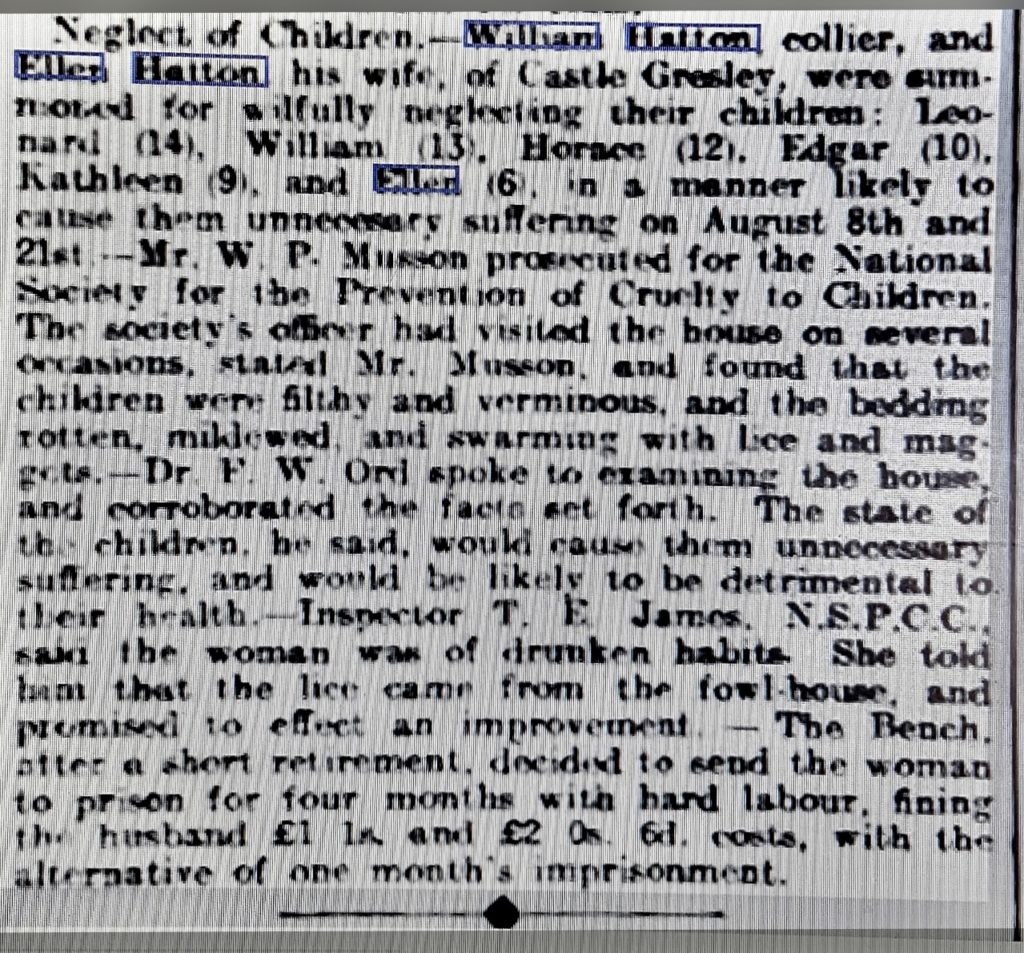
The case was brought against them by the National Society for the Prevention of Cruelty to Children. The society’s office had visited the house on several occasions, according to the prosecuting lawyer, Mr Musson, and found that the children were filthy and verminous, and the bedding rotton, mildewed, and swarming with lice and maggots.
Another official, Dr. F. W. Ord Had examined the house, and said the state of the children would cause them unnecessary suffering, and would be likely to be detrimental to their health.
The NSPCC Inspector T. E. James, said Ellen was “of drunken habits“. She told him that the lice came from the fowl house and promised to effect an improvement.
The Bench decided to send Ellen to prison for four months with hard labour, While William was fined £1 1s and £2 0s 6d costs, with the alternative of one month’s imprisonment. That would be the equivalent of about $600 today.
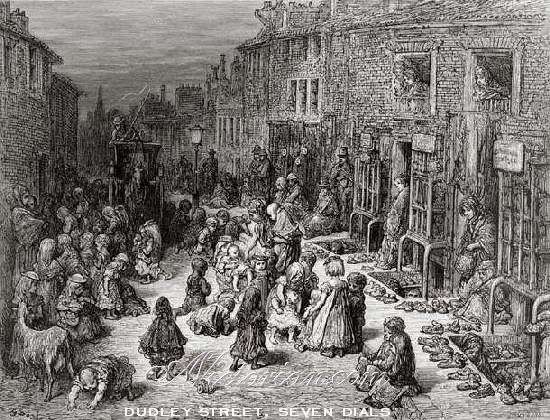
The Hattons were probably not poverty stricken ~ though Ellen’s drinking wouldn’t have helped. But if William was working long hours, and Ellen was an alcoholic, it’s easy to see why things got out of control.
Sociologist Thora Hands has written a fascinating treatise on alcohol in society in Victorian and Edwardian times:
People share a complex relationship with alcohol that spans time and place but importantly, it is a relation- ship that involves the agency of consumers. This is why the story of drink in late Victorian and Edwardian Britain resonates today. We live in the consumer society that emerged from late nineteenth century indus- trial capitalism. The technological advances, production and advertising techniques developed during this time not only turned alcohol into a mass-produced commodity but also gave life to the idea of the consumer. People’s drinking behaviour may have been shaped and constrained within a political, medical and moral framework but legislation and pub- lic health initiatives only went so far to control drinking behaviour within a political and economic system geared up for mass production and consumption.
Drinking in Victorian and Edwardian Britain, Thora Hands (Palgrave Macmillan)
A sad story, to be sure – but one that may well have been common in Edwardian times. Working-class women made and sometimes sold their own home-brewed alcohol. They drank to socialise or celebrate or sometimes for health during pregnancy and after childbirth. Doctors were still prescribing alcohol for pain relief.
Marketing alcohol as a tonic was one way to reach consumers and boost sales during a period when the drink trade faced moral and political hostility. By simply rebranding products to include the word ‘tonic’ on labels, alcohol producers boosted the market and ensured increased sales.
Thora Hands concludes “Drunkenness prevailed throughout the Victorian and Edwardian periods just as it does today. The real problem with alcohol is the one alluring quality of the substance—it gets people drunk”.
The skeleton in the cupboard, it turns out, was a substance that was willingly put there.