

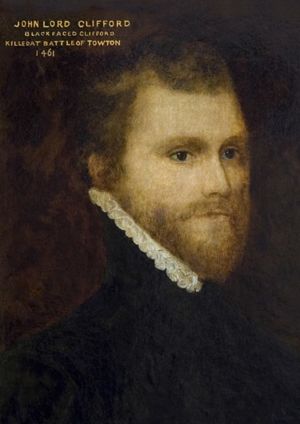
17th Great Uncle
John de Clifford is probably not the kind of uncle you’d want to invite round for Christmas, He first appears in February 1458, at Temple Bar and Westminster in London, where he was demanding compensation for the death of his father at St. Albans, who had been killed in the battle there, three years earlier in 1455, the opening battle of the Wars of the Roses. The king, Henry VI, and his council intervened, and ordered the Duke of York and the Earls of Salisbury and Warwick to establish masses for the souls of the slain nobles and to pay their representatives ‘a notable sum of money.’
Clifford seems now to have been perfectly reconciled with his former enemies, and in 1459 he was made commissary-general of the Scots marches, and a conservator of the truce with Scotland. In July 1460 he was summoned to parliament.
He was one of the Lancastrian leaders at the battle of Wakefield in December 1460, where he is reported to have slain the Earl of Rutland, the young son of the Duke of York, with his own hands.
Clifford led the Lancastrian right wing at the battle, a surprise attack on the Yorkist stronghold of Sandal Castle. The battle was a complete Lancastrian victory in which the Yorkist army was destroyed, their leader the Duke of York killed and his son Edmund and brother-in-law the Earl of Salisbury were captured.
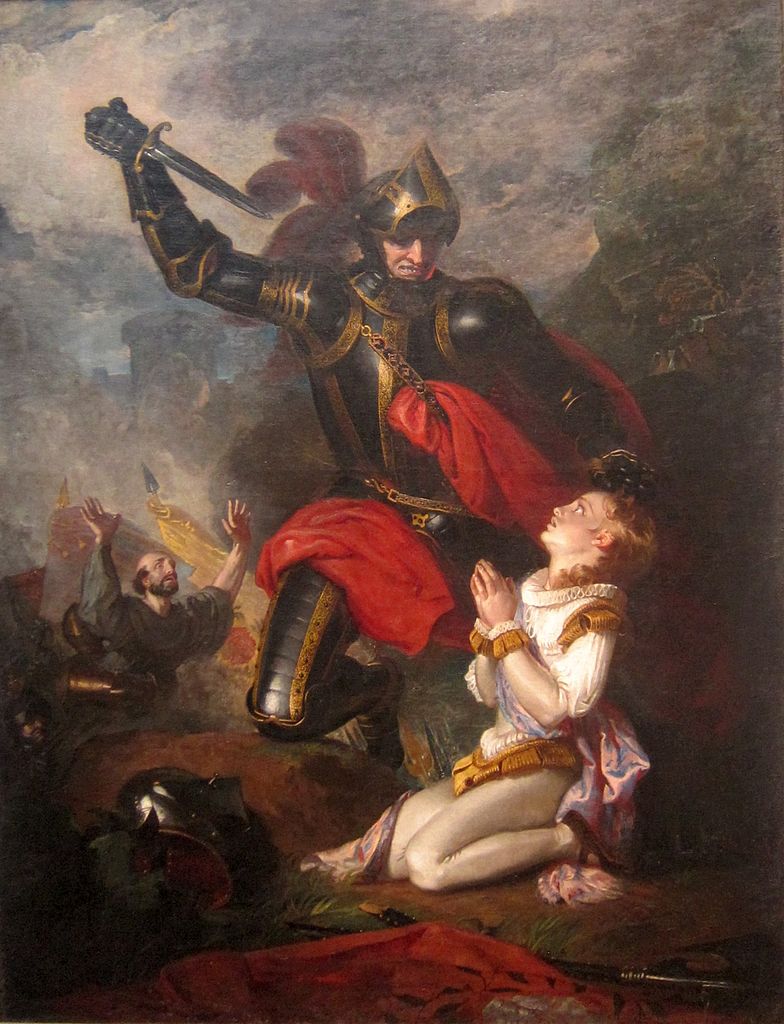
For his acts of cruelty he is said to have received the nickname of ‘the Butcher’. In the same battle he is charged with having cut off the head of the dead Duke of York and presented it, decked with a paper crown, to Queen Margaret.
Clifford is perhaps most famous for the killing of Edmund following the battle, an act contemporary chroniclers agreed he committed himself rather than ordering done. The killing went against tradition as captured sons of nobles were usually ransomed. Because Edmund was 17, the second (of four) sons rather than a leader or heir apparent, militarily inexperienced (Wakefield is his only known battle he fought in), and was wounded and defenceless when he was killed, his death was viewed as murder by the Yorkist faction and looked upon with disfavour by his fellow Lancastrian leaders, though Clifford defended the killing as a just execution no different than the beheading of Edmund’s uncle the Earl of Salisbury following the battle (though Salisbury was elderly and had participated in numerous battles against the Lancastrians). The act earned no formal disapproval from Queen Margaret, regent for her son Prince Edward during the mental illness of her husband King Henry VI, so Clifford suffered no repercussion, though it infuriated Edmund’s older brother Edward (who was in Wales at the time of the battle) who vowed vengeance and may have given Clifford his nickname “the Butcher”. (In much later histories Clifford was also referred to as “Black-faced Clifford”.)
Clifford was killed at Ferrybridge on the eve of the Battle of Towton in the following year, struck by an arrow in the throat after having carelessly removed his gorget. When Edward Duke of York became King Edward IV the widowed Lady Clifford, fearing her son Henry would be killed as retaliation for the new king’s brother, sent him into hiding.
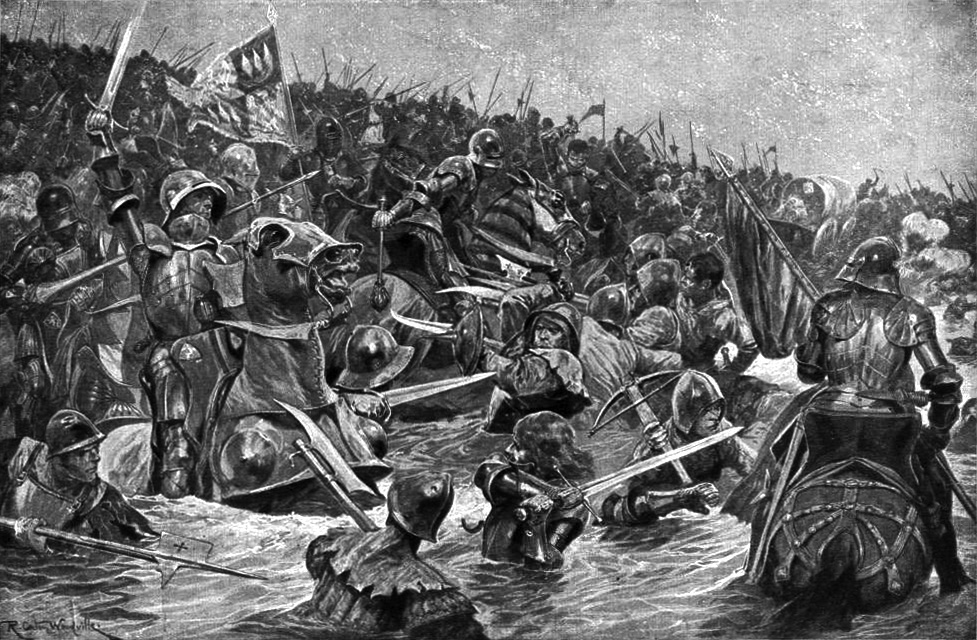
The Battle of Towton was the bloodiest ever fought on British soil, with casualties believed to have been in excess of twenty thousand (perhaps as many as thirty thousand) men. The battle took place on a snowy 29 March 1461 (Palm Sunday) on a plateau between the villages of Towton and Saxton in Yorkshire (about 12 miles southwest of York and about 2 miles south of Tadcaster).
Part of the reason so many died is perhaps because in the parley before the battle both sides agreed that no quarter would be given or asked, as they hoped to end it there and then.
The same year John was attainted by act of parliament. In English criminal law, attainder or attinctura was the metaphorical “stain” or “corruption of blood” which arose from being condemned for a serious capital crime. It entailed losing not only one’s life, property and hereditary titles, but typically also the right to pass them on to one’s heirs. His barony of Skipton went to Sir William Stanley, that of Westmoreland to Richard of Gloucester.
Clifford is a major character in William Shakespeare’s play, Henry VI, Part 3, in which he is portrayed as thirsty for revenge following the death of his father, and personally responsible for the death of Edmund, Earl of Rutland. Modern works in which he is depicted include Sharon Kay Penman’s novel The Sunne in Splendour. He left three children, of whom the eldest, Henry, is the hero of one of Wordsworth’s happiest poems, Song at the Feast of Brougham Castle.