
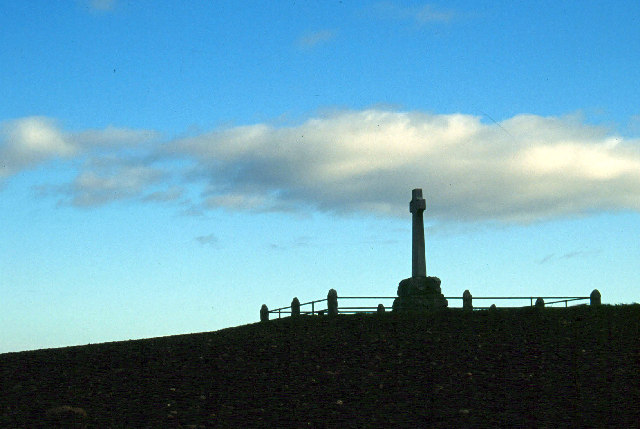
A battle that did not go well for us.
The Battle of Flodden Field, which happened on September 9th 1513, did not go well for our family – four of our 16th-great grandfathers were killed and one of our 16th-great uncles.
Sir William Knox of Ranfurly, his father Sir Uchtred Knox, Sir Alexander Ramsay, Lord David Wemyss and Thomas Otterburn were all slain by the English in the battle, fought at Branxton in Northumberland, between an invading Scots army under King Jmes IV and an English army commanded by the Earl of Surrey. In terms of troop numbers, it was the largest battle fought between the two kingdoms. James IV was killed in the battle, becoming the last monarch from the British Isles to die in battle.
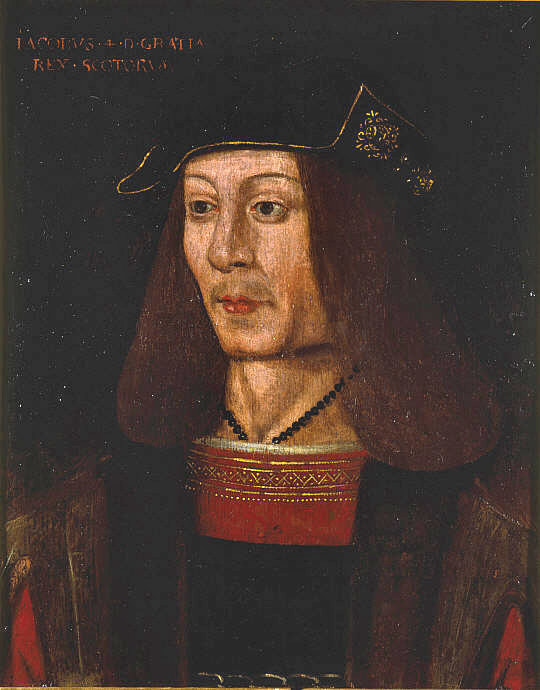
This conflict began when James IV declared war on England to honour the ‘Auld Alliance’ with France by diverting English King Henry VIII’s English troops from their campaign against the French king Louis XII. Henry VIII had also opened old wounds by claiming to be the overlord of Scotland, which angered the Scots and their King.
The battle actually took place near the village of Branxton rather than at Flodden—hence the alternative name is Battle of Branxton.
On 22 August 1513 James crossed the river Tweed, the historical boundary between Scotland and England, with the largest-ever Scottish army to invade England. His success was immediate. He took all the major fortresses in Northumberland.
On 5 September the Earl of Surrey (the commander of Henry’s army) sent diplomat Thomas Hawley to the Scottish side with an offer of battle. The next day James sent his own Islay Herald back to Surrey, accepting the challenge. The armies would go to battle on the 9th.
James’s army was in a fantastic position on the top of Flodden Hill, and to attack would have been suicidal for Surrey. So he sent Hawley back to argue that the sides had agreed to fight on flat ground.
Outraged, James communicated his fury with the words “that it was not fitting for an earl to seek to command a king”.
The next day, Surrey moved his army north-eastwards towards Berwick. The following morning they doubled back, and James realised they were going to attack his army from the rear.
James got to Surrey’s intended position – Branxton Hill – first. He still had the advantage of higher ground.
At 4pm there was an exchange of artillery fire, but neither the guns nor, indeed, the archers worked well because of appalling weather.
James launched a pike attack against the English right flank. It began to crumble. Panic threatened to grip the entire English army. This was a decisive moment. Surrey now threw in his reserve and held the line.
James’s second line attacked but hit boggy ground, and so all momentum was lost.
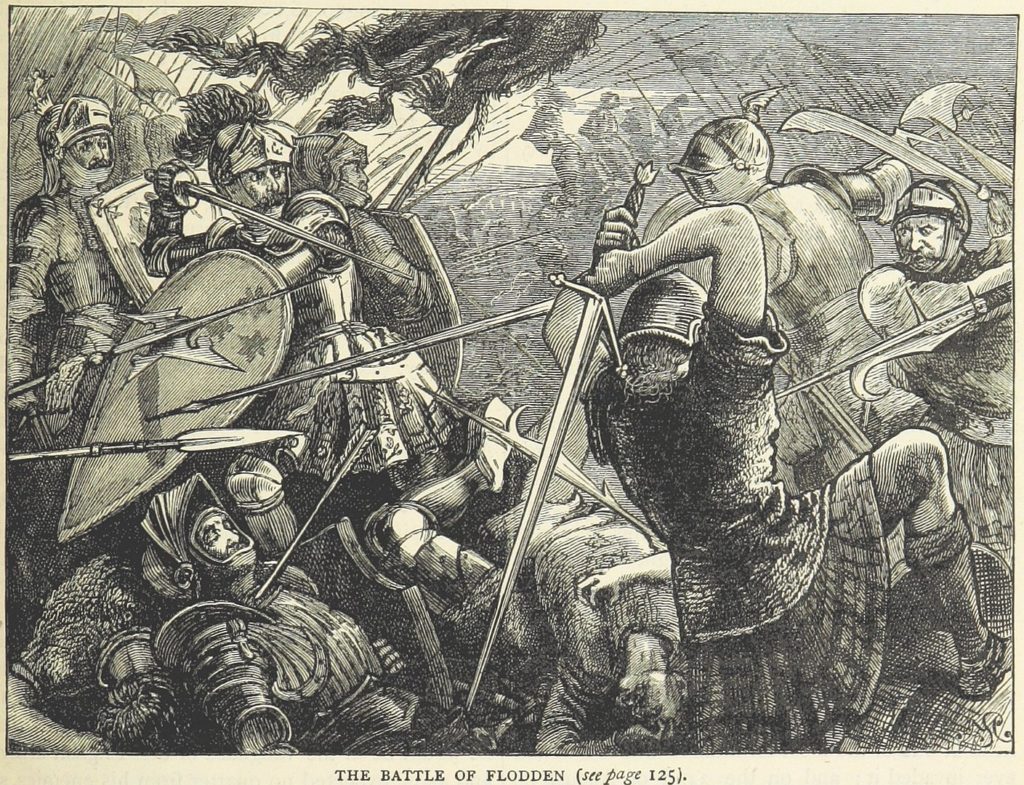
They dropped their pikes and brought out their swords, but were then fighting against the 8½ foot bill, an adapted agricultural scything tool. The English common soldier now had the advantage.
Flodden was essentially a victory of the bill used by the English over the pike used by the Scots. The pike was an effective weapon only in a battle of movement, especially to withstand a cavalry charge. The Scottish pikes were described by the author of the Trewe Encounter as “keen and sharp spears 5 yards long”. Although the pike had become a Swiss weapon of choice and represented modern warfare, the hilly terrain of Northumberland, the nature of the combat, and the slippery footing did not allow it to be employed to best effect. This battle was also one of the first major engagements in the British Isles where artillery was significantly deployed.
There were various conflicting accounts of the Scottish loss. A contemporary account produced in French for the Royal Postmaster of England, in the immediate aftermath of the battle, states that about 10,000 Scots were killed. Scotland went into shock at the loss of a great king. But 17-month-old James V was crowned just over a week later, and the basic administration of Scotland held together.
Nearly every noble family in Scotland would have lost a member at Flodden. The dead are remembered by the song (and pipe tune) ‘Flowers of the Forest’. Due to the content of the lyrics and the reverence for the tune, it is one of the few tunes that many pipers will perform in public only at funerals or memorial services.
Interestingly, James can be claimed by both sides of the Scottish independence debate. By the ‘yes’ campaign as the king who believed he had finally negotiated independence for the Scots; and by the ‘no’ campaign as the father of the line of eventual Stuart kings of both Scotland and England starting with James VI and I. He and not Henry VIII is a key ancestor of Elizabeth II.