

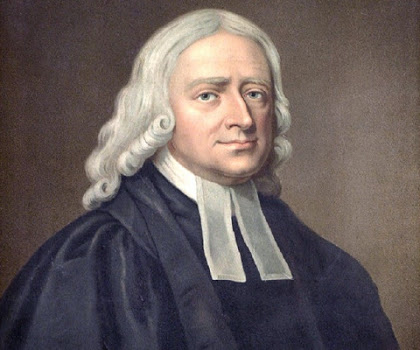
Third great-grandfather Richard Beard
There are strong connections to Methodism in the family, and a potentially fascinating connection to one of the leading lights of Methodism. The clue came when Ancestry.com turned up this tantalising entry about 3rd great-grandfather Richard Beard who was born in Devonport in Devon:
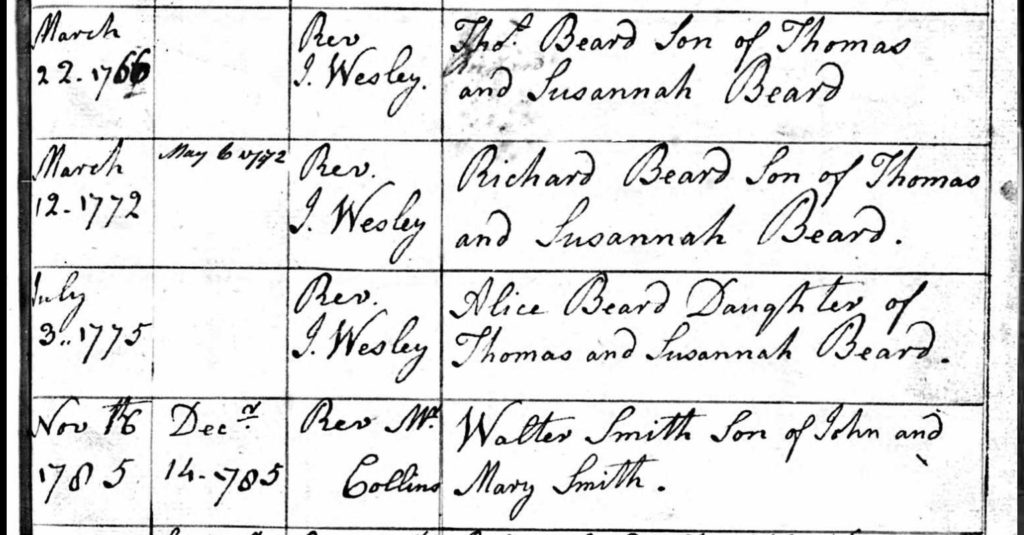
The entry in the register of non-conformist baptisms sees the children of Thomas and Susannah Beard baptised by a Rev J Wesley. Could this be THE John Wesley? Wesley was an English cleric, theologian and evangelist who was a leader of a revival movement within the Church of England known as Methodism. The societies he founded became the dominant form of the independent Methodist movement that continues to this day.
Luckily, we have a friend in Hamilton, New Zealand, Frank, who is a Wesleyan Methodist minister. He very kindly checked through Wesley’s diaries which were published – and his whereabouts on that date aren’t mentioned. So it’s not evidence that he was there – but similarly, not evidence that he WASN’T there.
Delving into the records held by the Mormon Church, we discover that the baptism took place at the Morice Street Wesleyan Methodist Church in 1772. Devonport local historians have discovered that the Morice Street Wesleyan Methodist Chapel was situated in Morice Street, between Granby Street and Cannon Street.
This Chapel started as the “Higher Room” in Princes Street, where workers from the parent Ker Street Wesleyan Methodist Chapel began services. The Chapel was erected in 1807, so it’s likely that the baptism took place in the ‘higher room’.
Another local historian told us via Facebook that Thomas Beard is listed as one of the original founding members of the church, so that would add to the circumstantial evidence.
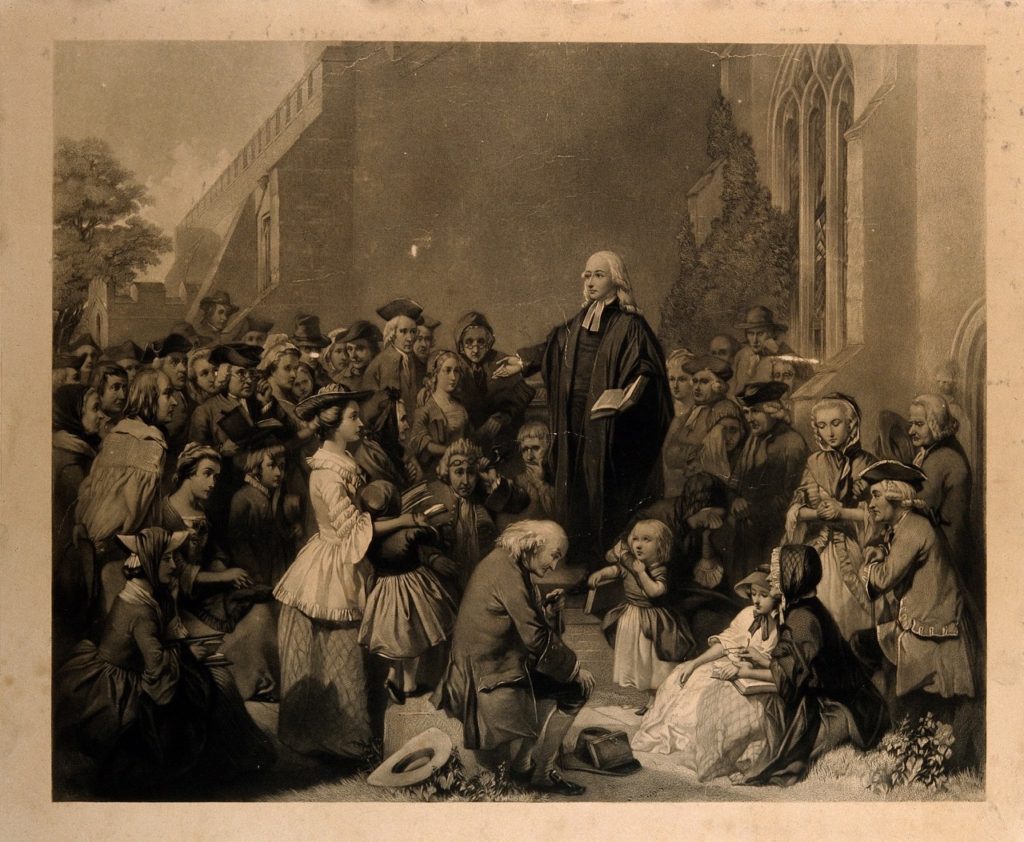
Wikipedia has this to say about Methodism: The movement which would become the Methodist Church began in the mid-18th century within the Church of England. A small group of students, including John Wesley, Charles Wesley and George Whitefield, met at Oxford University. They focused on methodical study of the Bible and living a holy life. Other students mocked them, saying they were the “Holy Club” and “the Methodists”, being methodical and exceptionally detailed in their Bible study, opinions and disciplined lifestyle.
Early Methodists were systematic in collecting statistics on membership. Their growth was rapid, from 58,000 in 1790 to 302,000 in 1830 and 518,000 in 1850. Those were the official members, but the national census of 1851 counted people with an informal connection to Methodism, and the total was 1,463,000. The movement was particularly strong in those early years in Devon and Cornwall, and apparently sent a number of missionaries to Australia.
So in the end, as far as our family is concerned, I guess we’ll never know for sure. But it would be nice to think our family had a connection with such a historical figure as John Wesley.